
Cloud Backup Market Size to Exceed USD 33.45 Billion by 2035 as AI-Driven Cyber Resilience and Explosive Data Growth Accelerate Adoption
Rising ransomware threats, enterprise digital transformation, and increasing cloud-native workloads are driving strong demand for scalable cloud backup solutions worldwide.
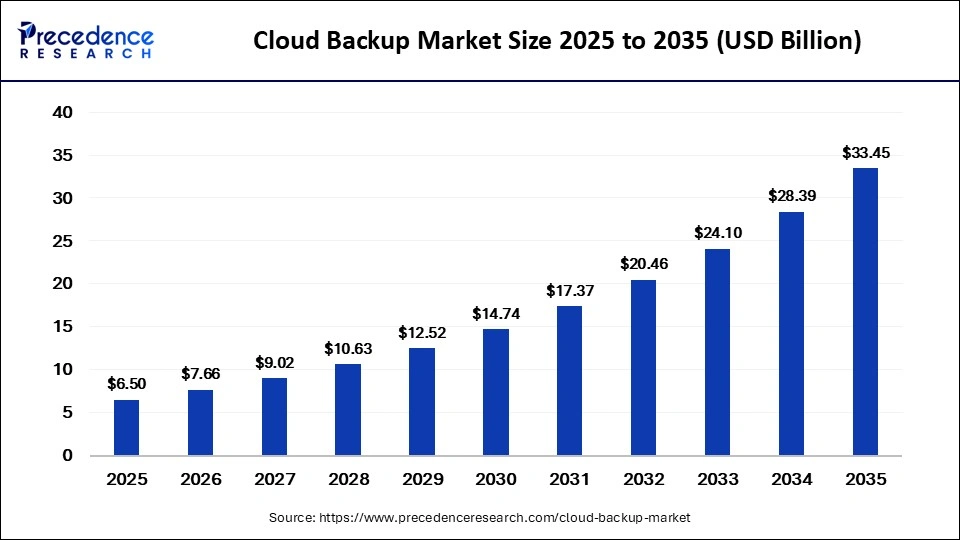
According to Precedence Research, the global cloud backup market size was valued at USD 6.50 billion in 2025 and is projected to grow from USD 7.66 billion in 2026 to approximately USD 33.45 billion by 2035, expanding at a CAGR of 17.80% during the forecast period. The rapid surge in enterprise data creation, growing cybersecurity threats, and increasing reliance on cloud infrastructure are transforming cloud backup from a disaster recovery tool into a critical component of modern business continuity strategies.
Cloud Backup Market Key Insights
- The global cloud backup market was valued at USD 6.50 billion in 2025 and is expected to reach USD 33.45 billion by 2035, growing at a CAGR of 17.80% between 2026 and 2035.
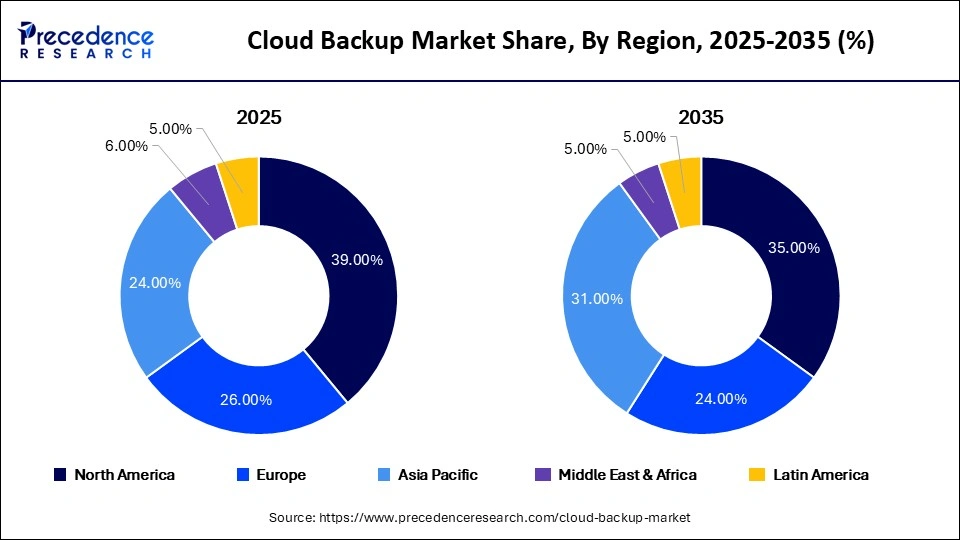
- North America dominated the global market with a 39% revenue share in 2025, supported by advanced cloud infrastructure and widespread enterprise adoption.
- Asia-Pacific is projected to register the fastest growth, expanding at a CAGR of 20.5% through 2035 due to accelerating digital transformation and rising SME cloud adoption.
- The public cloud backup segment accounted for the largest deployment share of 48% in 2025, while hybrid cloud backup is expected to witness significant future growth.
- Large enterprises generated 68% of total market revenue in 2025, reflecting increasing investments in cyber resilience and regulatory compliance.
- Among end-use industries, the BFSI sector led the market with a 22% share, whereas healthcare is anticipated to record the fastest growth during the forecast period.
Cloud Backup Market Snapshot
| Market Metrics | Details |
|---|---|
| Market Size (2025) | USD 6.50 Billion |
| Market Size (2026) | USD 7.66 Billion |
| Forecast Value (2035) | USD 33.45 Billion |
| CAGR (2026–2035) | 17.80% |
| Leading Region | North America |
| Fastest Growing Region | Asia-Pacific |
| Base Year | 2025 |
| Forecast Period | 2026–2035 |
Why is the Cloud Backup Market Experiencing Rapid Growth?
The rapid expansion of enterprise data is fundamentally reshaping the global cloud backup landscape. Organizations across industries are producing unprecedented volumes of structured and unstructured data through connected devices, cloud applications, IoT platforms, artificial intelligence, and digital business operations. Traditional on-premises storage infrastructures are increasingly unable to handle these growing workloads efficiently, prompting enterprises to migrate toward scalable cloud-based backup solutions.
The increasing sophistication of ransomware attacks has further accelerated market growth. Businesses are recognizing that secure, immutable, and geographically distributed backups are essential to ensuring uninterrupted operations following cyber incidents. Modern cloud backup platforms not only store data but also provide automated disaster recovery, continuous replication, encryption, compliance management, and rapid restoration capabilities, making them indispensable for organizations seeking operational resilience.
Growing remote work environments and hybrid IT infrastructures are also fueling demand. Enterprises require backup systems capable of protecting workloads distributed across multiple cloud platforms, virtual machines, SaaS applications, and edge environments. These evolving business requirements continue to create substantial opportunities for cloud backup vendors worldwide.
How is Artificial Intelligence Transforming the Cloud Backup Market?
Artificial intelligence has become one of the most influential technologies redefining cloud backup services. Rather than functioning solely as storage repositories, modern cloud backup platforms are evolving into intelligent data protection ecosystems powered by AI and machine learning algorithms.
AI enables organizations to automate backup scheduling based on data usage patterns, identify suspicious activity before ransomware spreads, classify sensitive information for regulatory compliance, optimize storage allocation through intelligent deduplication, and recommend recovery priorities during disaster events. This significantly reduces operational complexity while improving business continuity.
Machine learning also enhances cyber resilience by continuously monitoring backup environments for anomalies. Instead of discovering attacks after systems have already been compromised, AI-driven analytics detect unusual encryption behaviors, unauthorized access attempts, and abnormal data modifications in real time. This proactive approach enables organizations to isolate affected workloads quickly and recover clean backup copies before extensive business disruption occurs.
What are the Major Growth Factors Driving the Cloud Backup Market?
Explosive Enterprise Data Generation
Digital transformation initiatives across banking, healthcare, manufacturing, retail, telecommunications, and government sectors continue generating enormous amounts of business-critical information. Organizations require virtually unlimited storage capacity without investing heavily in physical infrastructure, making cloud backup an increasingly attractive solution.
Increasing Cybersecurity Threats
Ransomware remains one of the biggest challenges facing enterprises worldwide. Organizations are investing heavily in immutable cloud backups and automated disaster recovery systems to minimize downtime and financial losses following cyberattacks.
Growing Adoption of Hybrid and Multi-Cloud Environments
Businesses are increasingly deploying workloads across multiple cloud providers while maintaining certain applications on private infrastructure. This hybrid operating model has significantly increased demand for centralized backup platforms capable of protecting data across diverse environments.
Regulatory Compliance Requirements
Global data privacy regulations require organizations to securely retain and recover business information. Cloud backup solutions provide automated compliance reporting, encryption, secure retention policies, and disaster recovery capabilities that simplify regulatory adherence.
What Opportunities are Emerging in the Cloud Backup Market?
Can Infrastructure Investments Unlock New Growth Opportunities?
Cloud providers continue investing heavily in regional data centers and edge computing infrastructure to reduce latency, improve data sovereignty, and enhance backup performance. These investments enable organizations to recover critical information faster while meeting local regulatory requirements.
Why are Predictable Pricing Models Becoming Increasingly Important?
Enterprises are becoming more cost-conscious as cloud storage volumes expand. Vendors offering transparent pricing, flat-rate bandwidth, and reduced egress fees are gaining competitive advantages by helping organizations better manage long-term cloud storage costs.
Will Cloud-Native Applications Continue Expanding Market Demand?
Absolutely. As organizations modernize applications using containers, Kubernetes, and microservices architectures, demand for intelligent cloud-native backup solutions capable of protecting virtual machines and containerized workloads is expected to accelerate substantially.
Cloud Backup Market Segmentation
Deployment Model Analysis
The public cloud backup segment accounted for the largest market share of 48% in 2025 and is projected to expand at the fastest CAGR of 18.5% during the forecast period. Its leadership is driven by cost-effective deployment, high scalability, and growing demand for secure off-site data protection. Rising ransomware attacks and stringent regulations such as GDPR and CCPA have encouraged organizations to adopt automated cloud backup solutions for improved disaster recovery and regulatory compliance.
The hybrid cloud backup segment captured 30% of the market in 2025 and is expected to grow at a CAGR of 17% through 2035. Increasing demand for flexible workload management, regulatory compliance, and seamless integration with legacy infrastructure is fueling growth. Hybrid environments also support AI and machine learning applications while ensuring sensitive data remains secure in private cloud environments.
The private cloud backup segment held 22% of the market share in 2025 and is anticipated to grow at a CAGR of 14%. Demand is supported by strict data sovereignty regulations, enhanced security requirements, and the need to protect sensitive enterprise data. Organizations continue to invest in private cloud backup to strengthen disaster recovery while reducing dependence on costly on-premises infrastructure.
Organization Size Analysis
Large enterprises dominated the cloud backup market with a 68% share in 2025. The growing volume of enterprise data, strict regulatory compliance requirements, and the need for reliable disaster recovery across multiple locations continue to drive cloud backup adoption among large organizations.
Small and medium-sized enterprises (SMEs) represented 32% of the market in 2025 and are expected to register the fastest CAGR of 19.8% during the forecast period. Affordable subscription-based cloud services and increasing adoption of remote and hybrid work models are encouraging SMEs to invest in scalable cloud backup solutions.
Backup Type Analysis
The application backup segment accounted for the largest 28% market share in 2025. Rapid adoption of SaaS applications, protection of business-critical workloads, and compliance with industry regulations have significantly increased demand for application backup solutions.
The VM and container backup segment held 18% of the market in 2025 and is projected to grow at the fastest CAGR of 20%. Growth is supported by expanding cloud-native infrastructure, increasing containerized workloads, and the rising need for scalable disaster recovery solutions.
The database backup segment captured 24% of the market in 2025 and is expected to grow at a CAGR of 16%. Rising cyber threats, ransomware attacks, and increasing enterprise data volumes are driving organizations to adopt secure cloud-based database backup solutions.
End-Use Industry Analysis
The BFSI sector led the cloud backup market with a 22% share in 2025. Financial institutions continue to adopt cloud backup solutions to meet strict regulatory requirements, strengthen cybersecurity, and ensure business continuity through real-time disaster recovery.
The healthcare segment accounted for 14% of the market in 2025 and is projected to grow at the fastest CAGR of 19.5%. Growing adoption of electronic health records (EHRs), expanding medical imaging data, and rising cyberattacks on healthcare institutions are driving demand for secure cloud backup solutions.
The IT and telecom segment represented 20% of the market in 2025 and is expected to grow at a CAGR of 16.5%. Increasing cloud adoption, expanding SaaS ecosystems, and the shift toward remote work are fueling demand for reliable and scalable cloud backup services.
Cloud Backup Market Regional Analysis
North America Lead the Cloud Backup Market
North America accounted for the largest 39% market share in 2025. High cloud adoption, increasing ransomware attacks, and strict data protection regulations continue to drive regional growth. The presence of leading cloud providers such as AWS, Microsoft Azure, and Google Cloud further strengthens market expansion.
U.S. Market Outlook
The U.S. cloud backup market was valued at USD 1.90 billion in 2025 and is expected to reach USD 9.98 billion by 2035, growing at a CAGR of 18.04%. Growth is supported by rapid enterprise digital transformation, remote work adoption, and increasing cybersecurity investments.
Europe: The Second-Largest Regional Market
Europe captured 26% of the global market in 2025 and is projected to grow at a CAGR of 16%. GDPR compliance, rising hybrid cloud deployments, and growing enterprise digitization are encouraging organizations to invest in automated cloud backup and disaster recovery solutions.
UK Market Analysis
The UK market is expanding due to strict data protection regulations, increasing cyber threats, and growing adoption of cloud infrastructure among SMEs seeking cost-effective storage and backup solutions.
Asia-Pacific: The Fastest-Growing Region
Asia-Pacific held 24% of the market in 2025 and is expected to register the fastest CAGR of 20.5%. Rapid digital transformation, rising SME cloud adoption, and increasing data generation across industries continue to accelerate regional market growth.
China Market Analysis
China’s market is driven by rapid data growth, government-led digital transformation initiatives, strict data localization policies, and expanding investments in hyperscale cloud infrastructure.
Latin America Market Outlook
Latin America accounted for 6% of the market in 2025 and is expected to grow at a CAGR of 15%. Rising cloud migration, increasing cyberattacks, and expanding fintech adoption are encouraging organizations to deploy resilient cloud backup solutions.
Brazil Market Analysis
Brazil continues to witness strong growth due to increasing ransomware incidents, digital transformation initiatives, and evolving data sovereignty regulations requiring secure local data storage.
Middle East & Africa Market Outlook
The Middle East and Africa represented 5% of the global market in 2025 and are projected to grow at a CAGR of 16.5%. Expansion of regional data centers, increasing enterprise cloud adoption, and stronger cybersecurity initiatives are driving demand for cloud backup solutions.
Saudi Arabia Market Analysis
Saudi Arabia’s cloud backup market is supported by Vision 2030 initiatives, strict data residency regulations, growing cybersecurity investments, and large-scale smart city projects that require secure and scalable data protection infrastructure.
Cloud Backup Market Key Players
1. Enterprise Data Platform Leaders
Veeam Software
-
Core Offerings: Veeam Data Platform (incorporating Veeam Backup & Replication) and Veeam Data Cloud (a fully managed SaaS offering).
-
Capabilities: Flexible, software-defined framework protecting virtual (VMware, Hyper-V), physical, and multi-cloud (AWS, Azure, Google Cloud) environments. Includes Veeam Cloud Vault (managed immutable cloud storage targets) and dedicated, SaaS-based protection for Microsoft 365, Salesforce, and Kubernetes (via Kasten).
Commvault Systems
-
Core Offerings: Commvault Cloud (unified data resilience platform powered by Metallic AI).
-
Capabilities: Combines enterprise software-defined backup with native SaaS delivery. Protects complex multi-cloud hybrid setups, databases (SQL, Oracle), and SaaS applications (M365, Google Workspace, Salesforce). Features Air Gap Protect for isolated, immutable cloud vaulting and Clumio for Google Cloud Storage (acquired tool for petabyte-scale AI data lakes and rapid object recovery).
Veritas Technologies
-
Core Offerings: Veritas NetBackup, Backup Exec (for mid-market), and Veritas Alta (cloud-native data management suite).
-
Capabilities: Built for legacy and massive heterogeneous enterprise data centers. Veritas Alta delivers a secure cloud data plane protecting IaaS, PaaS, and SaaS workloads. It provides automated application failover, AI-driven anomaly detection via Alta Copilot, and intelligent cross-cloud tiering for long-term retention.
2. Zero-Trust & Cyber Resilience Pioneers
Rubrik
-
Core Offerings: Rubrik Security Cloud (RSC).
-
Capabilities: Built on an immutable, file-system-level architecture where data cannot be modified once written. It offers native cloud backup for AWS, Azure, and GCP, alongside SaaS protection (M365, Jira, Salesforce). Focuses on security automation: active threat hunting within backups, sensitive data discovery (to prevent exfiltration risks), and automated, clean cyber-recovery workflows.
Cohesity
-
Core Offerings: Cohesity Data Cloud and Cohesity Cloud Services (SaaS-delivered backup).
-
Capabilities: Focuses on data consolidation, turning secondary backup storage into an efficient data management tier. It provides scale-out architecture available as an appliance, customer-managed cloud software, or pure SaaS across AWS, Azure, and GCP. Features AI-powered ransomware threat analytics and deep data-reduction features (global deduplication).
3. Pure SaaS-Native Platforms
Druva
-
Core Offerings: Druva Data Resiliency Cloud.
-
Capabilities: A 100% SaaS platform built natively on AWS. Requires no on-premises hardware or virtual appliance staging. It offers unified, air-gapped protection across endpoints (laptops), data centers (VMs, databases), cloud-native workloads, and SaaS stacks (M365, Salesforce, Google Workspace) under a predictable OpEx subscription model.
HYCU
-
Core Offerings: HYCU Protégé.
-
Capabilities: Specifically engineered for multi-cloud and modern SaaS applications. Rather than using agents, it integrates directly via cloud provider APIs (for AWS, Google Cloud, Azure, and Nutanix). Known for R-Cloud, an integration platform that allows developers to rapidly build native backups for emerging SaaS apps and enterprise tools (like Jira, Confluence, Okta, and Asana).
4. Mid-Market & MSP-Focused Suites
Acronis International
-
Core Offerings: Acronis Cyber Protect and Acronis Cyber Protect Cloud (for MSPs).
-
Capabilities: Merges traditional image-based cloud backup with endpoint cybersecurity (anti-malware, patch management, and URL filtering) into a single agent. It targets SMBs and service providers looking to manage backup and device security through a unified, multi-tenant cloud console.
Arcserve
-
Core Offerings: Arcserve UDP (Unified Data Protection), Arcserve Cloud Hybrid, and Arcserve SaaS Backup.
-
Capabilities: Offers a blend of hardware appliances and cloud destinations. It focuses on broad environment protection (on-prem to cloud), continuous data replication, and high-density deduplication. Its SaaS backup provides cloud-to-cloud protection for standard collaboration platforms.
Unitrends
-
Core Offerings: Unitrends Backup Software and Unitrends Cloud Backup (a Kaseya company solution).
-
Capabilities: Highly localized around physical/virtual turn-key appliances that replicate seamlessly to the Unitrends Cloud. Provides “Forever Cloud” retention policies and features automated, proactive Recovery Assurance testing to spin up and verify compliance workloads automatically in the cloud.
5. Specialized Data Protection & Broad IT Management Vendors
Zerto
-
Core Offerings: Zerto platform (an HPE company).
-
Capabilities: Differs from standard snapshot-based daily backup by focusing heavily on Continuous Data Protection (CDP). It uses real-time replication with journaling to deliver near-zero Recovery Point Objectives (RPOs) for virtualized workloads shifting to or operating inside AWS and Azure, making it a premier cloud Disaster Recovery (DR) tool.
Quest Software
-
Core Offerings: Quest NetVault Backup, QoreStor (software-defined storage/deduplication), and Foglight.
-
Capabilities: NetVault provides enterprise-level cloud-connected backup for complex OS and database distributions (like SAP, Oracle, and SQL). QoreStor acts as an acceleration layer, deduplicating data locally before securely pushing compressed data sets to object storage tiers in the cloud.
Nakivo
-
Core Offerings: NAKIVO Backup & Replication.
-
Capabilities: A lightweight, cost-effective backup solution optimized for VMware, Hyper-V, Proxmox, and AWS EC2 instances. It supports direct backup archiving to public clouds (Amazon S3, Azure Blob, Wasabi, Backblaze B2) with built-in immutability.
OpenText
-
Core Offerings: OpenText Data Protector and Carbonite (acquired portfolio).
-
Capabilities: Data Protector serves large-scale, traditional IT spaces requiring complex tape-to-cloud tiering and application security. The Carbonite arm provides straightforward cloud-directed backup for small businesses, endpoints, and Microsoft 365 migrations.
Barracuda Networks
-
Core Offerings: Barracuda Cloud-to-Cloud Backup and Barracuda Backup Intronis.
-
Capabilities: Strongly integrated with physical or virtual security appliances. Barracuda excels at cloud-to-cloud backup specifically engineered for Microsoft 365 (Teams, Exchange, OneDrive, SharePoint), managed from a unified portal alongside their email security solutions.
Segments Covered in the Report
By Deployment Model
- Public Cloud Backup
- Private Cloud Backup
- Hybrid Cloud Backup
By Organization Size
- Large Enterprises
- SMEs
By Backup Type
- File & Folder Backup
- Application Backup
- Database Backup
- VM & Container Backup
- Endpoint Backup
By End-Use Industry
- BFSI
- IT & Telecom
- Healthcare
- Government
- Retail & E-Commerce
- Manufacturing
- Education
- Media & Entertainment
- Others
By Region
- North America
- Latin America
- Europe
- Asia-pacific
- Middle and East Africa
Also Read: Ethoxyquin Market Size to Attain USD 446 Million by 2035
Get this report to explore global market size, share, CAGR, and trends, featuring detailed segmental analysis and an insightful competitive landscape overview @ https://www.precedenceresearch.com/sample/8488
You can place an order or ask any questions. Please feel free to contact us at sales@precedenceresearch.com |+1 804 441 9344

- Cloud Backup Market Size to Exceed USD 33.45 Billion by 2035 as AI-Driven Cyber Resilience and Explosive Data Growth Accelerate Adoption - June 17, 2026
- Internet of Things (IoT) in Agriculture Market to Surge to USD 41.29 Billion by 2035 as AI-Powered Smart Farming Revolutionizes Global Food Production - June 15, 2026
- Wind Turbine Market Size to Exceed USD 339.43 Billion by 2035 Amid Accelerating Global Shift Toward Renewable Energy - June 15, 2026