
Internet of Things (IoT) in Agriculture Market to Surge to USD 41.29 Billion by 2035 as AI-Powered Smart Farming Revolutionizes Global Food Production
Rising Demand for Precision Agriculture, Smart Sensors, Farm Automation, and Sustainable Farming Practices Drives the Global IoT in Agriculture Market at an 8.79% CAGR Through 2035
The global Internet of Things (IoT) in Agriculture market is witnessing remarkable growth as farmers worldwide increasingly adopt connected technologies, artificial intelligence, automation systems, and precision farming solutions to improve productivity while optimizing resource utilization.
According to Precedence Research, the global Internet of Things in agriculture market size reached USD 17.78 billion in 2025 and is projected to grow from USD 19.47 billion in 2026 to approximately USD 41.29 billion by 2035, expanding at a CAGR of 8.79% during the forecast period from 2026 to 2035.
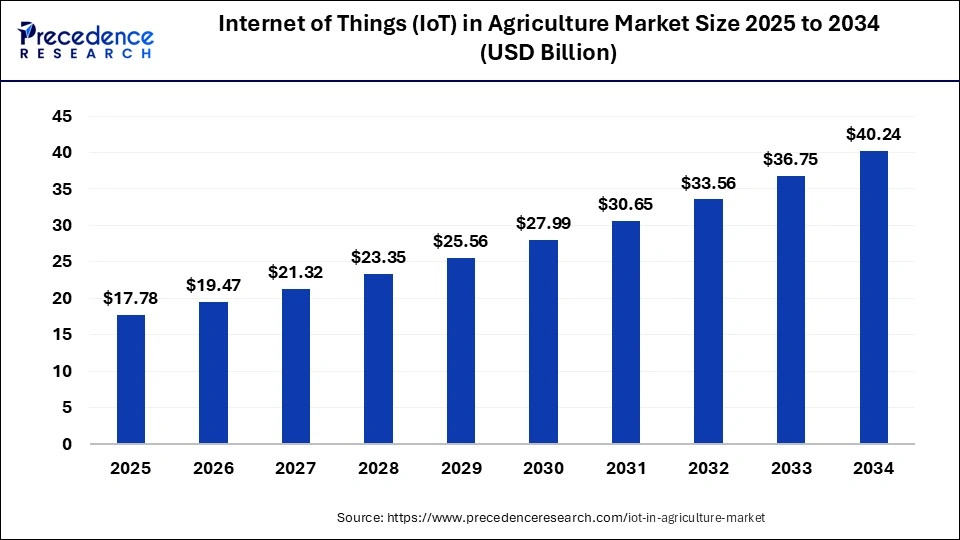
The market’s growth is primarily driven by rising food demand from a growing global population, shrinking arable land availability, increasing adoption of smart farming technologies, government support for agricultural digitization, and the growing need to maximize crop yields while minimizing water, fertilizer, and energy consumption. Modern technologies such as AI-powered analytics, GPS-guided machinery, remote sensing, smart sensors, drones, and automated irrigation systems are transforming traditional farming practices into highly efficient and data-driven operations.
Internet of Things in Agriculture Market Key Highlights
- The global IoT in agriculture market was valued at USD 17.78 billion in 2025 and is forecast to reach USD 41.29 billion by 2035.
- The market is expected to expand at a CAGR of 8.79% between 2026 and 2035.
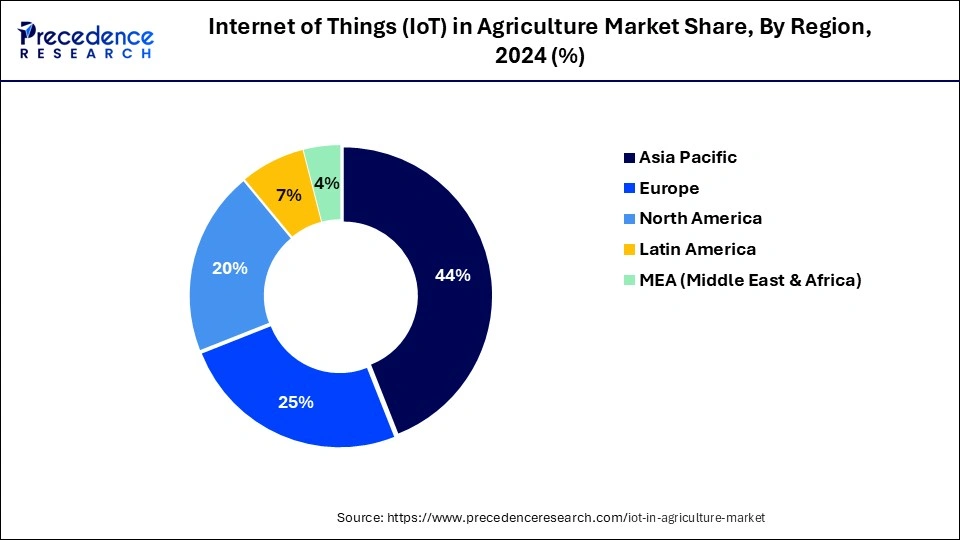
- Asia Pacific accounted for approximately 44% of global revenue in 2025, making it the largest regional market.
- The monitoring segment is expected to surpass USD 8 billion by 2035.
- Smart sensor systems are projected to generate more than USD 3.2 billion in revenue by 2035.
- The agriculture drones segment is anticipated to exceed USD 2.21 billion by 2035.
- Precision farming emerged as the leading application segment due to increasing adoption of data-driven agricultural management.
- Automation and control systems accounted for the largest share among technology segments.
- Leading industry participants include Trimble Inc., Deere & Company, AGCO Corporation, CropX, Climate Corporation, Farmers Edge, and Topcon Positioning Systems.
Why Is IoT Becoming the Backbone of Modern Agriculture?
Agriculture is experiencing one of the most significant technological transformations in its history. As global food demand rises and environmental pressures intensify, farmers are increasingly turning toward IoT-enabled solutions to improve operational efficiency and sustainability.
IoT technologies enable real-time collection of critical farm data through connected devices, sensors, drones, weather stations, and automated equipment. These systems help farmers monitor soil moisture, crop health, livestock conditions, water consumption, nutrient levels, and environmental factors with unprecedented accuracy.
The integration of connected technologies allows agricultural stakeholders to make informed decisions, reduce waste, improve productivity, and increase profitability. As a result, IoT has become a fundamental component of precision agriculture strategies worldwide.
How Is Artificial Intelligence Transforming the IoT in Agriculture Market?
Artificial intelligence is emerging as one of the most influential technologies within the IoT agriculture ecosystem. AI-powered algorithms analyze massive volumes of data collected from connected devices, enabling predictive insights that improve farm management decisions.
Machine learning systems can identify patterns in soil health, weather conditions, crop growth, and livestock behavior. These insights allow farmers to predict disease outbreaks, optimize irrigation schedules, forecast yields, and improve resource allocation.
Furthermore, AI-driven automation is reducing dependence on manual labor by enabling autonomous machinery, intelligent feeding systems, automated greenhouse management, and livestock monitoring solutions. This combination of AI and IoT is creating highly efficient farming environments that maximize output while minimizing environmental impact.
Beyond the farm, AI is improving agricultural supply chains by forecasting demand, optimizing logistics, reducing food waste, and enhancing traceability throughout the value chain. As digital agriculture continues to evolve, AI is expected to become a critical catalyst for market expansion.
Internet of Things in Agriculture Market Size Outlook
| Report Coverage | Details |
| Market Size in 2025 | USD 17.78 Billion |
| Market Size in 2026 | USD 19.47 Billion |
| Market Size by 2035 | USD 41.29 Billion |
| Growth Rate from 2026 to 2035 | CAGR of 8.79% |
| Base Year | 2025 |
| Forecast Period | 2026 to 2035 |
| Segments Covered | Component, Type, Application, and Region |
What Factors Are Accelerating Market Growth?
- Rising Adoption of Precision Agriculture Technologies: Precision agriculture has become one of the strongest growth drivers in the global market. Farmers increasingly rely on IoT-enabled systems to optimize field management, improve crop performance, and reduce operational costs. Connected sensors and analytics platforms provide valuable insights that support informed decision-making and improve overall farm productivity.
- Increasing Demand for Food Security: The growing global population is creating unprecedented pressure on agricultural production systems. IoT technologies help maximize crop yields while conserving critical resources, making them indispensable tools for ensuring long-term food security.
- Expansion of Smart Farming Infrastructure: Advancements in wireless connectivity, cloud computing, edge computing, and automation technologies are enabling widespread deployment of smart farming solutions. Improved internet access in rural regions is further supporting market growth.
- Focus on Sustainability and Resource Optimization: Governments and agricultural organizations worldwide are promoting sustainable farming practices. IoT systems help reduce water consumption, fertilizer usage, pesticide application, and energy expenditure, aligning with environmental sustainability goals.
- Growth of Livestock Monitoring Applications: Farmers are increasingly implementing connected livestock management systems to monitor animal health, feeding patterns, movement, and productivity. These technologies improve herd performance while reducing disease-related losses.
Internet of Things in Agriculture Market Opportunities
Smart farming technologies are enabling agricultural producers to significantly improve crop yields while reducing resource consumption. IoT-driven precision agriculture is expected to play a vital role in feeding the world’s growing population sustainably.
Connected farming solutions provide real-time insights into water usage, nutrient management, and environmental conditions. These capabilities help farmers reduce waste and improve sustainability, creating substantial opportunities for technology providers.
Agricultural drones equipped with advanced sensors, imaging technologies, and AI analytics are transforming crop monitoring, spraying, and field mapping operations. As costs decline and functionality improves, drone adoption is expected to accelerate globally.
Countries across Asia Pacific, Latin America, and Africa are increasingly investing in agricultural modernization. Rising awareness, supportive government initiatives, and growing smartphone penetration create substantial opportunities for IoT adoption in these regions.
Expert Perspective
According to Precedence Research, Principal Consultant
“The convergence of IoT, artificial intelligence, automation, and remote sensing technologies is fundamentally reshaping the future of agriculture. Farmers are moving beyond traditional practices toward intelligent, data-driven ecosystems capable of delivering higher productivity, improved sustainability, and stronger economic returns. Over the next decade, smart farming technologies will become essential tools for global food security.”
Internet of Things in Agriculture Market Segment Analysis
Type Analysis
The Internet of Things (IoT) in Agriculture market is segmented into automation and control systems, sensing and monitoring devices, livestock monitoring equipment, fish farming systems, smart greenhouse solutions, and software. Among these, the automation and control systems segment accounted for the largest market share in 2023.
Agricultural automation enables tasks that were once performed manually to be managed through machines and digital technologies. Farmers are increasingly adopting automation solutions to improve operational efficiency, reduce labor dependency, and enhance productivity. Automated tractor guidance systems, for example, allow operators to control farm machinery with the help of sensors and navigation technologies, improving field precision and reducing resource wastage.
Automation technologies have simplified key agricultural activities, including irrigation, pesticide spraying, and fertilizer application. These systems ensure the right amount of inputs is delivered to crops, increasing accuracy while lowering operational costs.
Remote monitoring technologies such as telematics and satellite communication systems also allow farmers to manage agricultural equipment and field activities from distant locations. This capability is particularly beneficial for farm owners who oversee multiple properties or have limited time for day-to-day operations.
Automation systems significantly reduce labor expenses and improve resource utilization. By optimizing the use of water, fertilizers, and pesticides, these technologies help farmers achieve higher yields while conserving valuable resources. Increased field precision also contributes to improved crop quality and farm profitability.
Application Analysis
Based on application, the IoT in Agriculture market is categorized into livestock monitoring, smart greenhouses, precision forestry, fish farm monitoring, precision farming, and others. The precision farming segment generated the highest revenue in 2023.
Precision farming utilizes advanced sensors, data analytics, and connected technologies to improve crop management decisions. The approach focuses on maximizing productivity while minimizing input costs through efficient resource allocation and real-time monitoring.
Precision farming helps optimize the use of water, fertilizers, and pesticides, leading to improved crop quality and increased agricultural output. By leveraging data-driven insights, farmers can make informed decisions that enhance efficiency and sustainability across farming operations.
The widespread adoption of remote sensing technologies and unmanned aerial vehicles (UAVs) has further accelerated the growth of precision agriculture worldwide. These tools provide accurate field-level information that supports better crop and soil management.
Satellite imagery and UAV-based monitoring systems deliver high-resolution data on soil conditions, crop health, and yield potential. Multispectral imaging technologies enable farmers to assess soil moisture levels, organic matter content, and nutrient composition.
These insights allow agricultural producers to identify fertility issues, optimize irrigation strategies, and improve overall crop performance, making precision farming one of the most valuable applications of IoT in agriculture.
Internet of Things in Agriculture Market Regional Analysis
Asia Pacific Leads the Global Market Growth
The Asia Pacific IoT in Agriculture market was valued at USD 8.57 billion in 2025 and is projected to reach approximately USD 19.97 billion by 2035, expanding at a CAGR of 8.83% from 2026 to 2035.
The region is expected to record the fastest growth rate during the forecast period due to its large agricultural base and rapidly growing populations in countries such as India and China. Increasing awareness of modern farming technologies and supportive government initiatives aimed at agricultural digitization are key factors driving market expansion.
Rising Demand for Smart Agriculture Solutions
Growing urbanization and increasing concerns regarding food security are encouraging the adoption of digital farming technologies across the region. Rising disposable incomes and evolving consumer preferences are also contributing to greater demand for efficient and sustainable agricultural production methods.
Government programs supporting agricultural modernization, combined with the availability of arable land, are expected to strengthen the adoption of IoT-based farming solutions throughout the forecast period.
Technology Adoption Accelerating Market Expansion
The integration of satellite imaging, remote sensing technologies, and improved connectivity infrastructure is enhancing the deployment of IoT solutions in agriculture. Increased smartphone penetration among farmers is further supporting the adoption of connected farming systems and digital agricultural platforms.
Europe Maintained the Second-Largest Market Share
Europe accounted for the second-largest revenue share in 2023. Growing awareness regarding the benefits of IoT-enabled farming has encouraged greater investments in smart agriculture technologies across the region.
The use of connected devices for monitoring crops, soil conditions, and agricultural assets has improved operational efficiency and supported sustained market growth.
Moderate Growth Expected in Latin America, Middle East, and Africa
The IoT in Agriculture market in Latin America, the Middle East, and Africa is expected to grow at a moderate pace during the forecast period. Increasing populations and rising demand for agricultural products in countries such as Brazil, Saudi Arabia, and South Africa are expected to create favorable growth opportunities.
As these regions continue to modernize agricultural practices, the adoption of IoT technologies is likely to increase, supporting long-term market development.
Internet of Things in Agriculture Market Value Chain Analysis
The IoT agriculture ecosystem involves multiple stakeholders working together to deliver connected farming solutions.
- Manufacturing: Component suppliers provide sensors, communication modules, and microcontrollers used in agricultural IoT systems.
- Key Players: John Deere, Trimble
- Research & Development: Companies develop advanced hardware and software solutions designed to improve automation and data analytics capabilities.
- Key Players: Robert Bosch GmbH, CropIn
- Hardware Manufacturing & Assembly: Manufacturers assemble, test, and validate agricultural IoT devices to ensure reliability and performance.
- Key Players: Deere & Company, Libelium
- Marketing & Sales: Market participants promote smart farming technologies and drive adoption among agricultural producers.
- Key Players: Farmers Edge, AGRIVI
- Technology Development: Cloud computing, analytics platforms, and IoT integration technologies continue to evolve.
- Key Players: Microsoft, IBM
Leading Companies Shaping the Internet of Things in Agriculture Market
Trimble Inc. – Estimated 2025 Revenue Share: 15.2%
Trimble Inc. is estimated to account for approximately 15.2% of the global Internet of Things (IoT) in Agriculture market revenue in 2025. The company offers an extensive portfolio of precision agriculture solutions, including GPS guidance systems, Trimble Ag Software, field mapping tools, variable rate application technologies, telematics solutions, and cloud-based farm data analytics that help growers optimize productivity and resource utilization.
Deere & Company – Estimated 2025 Revenue Share: 18.6%
Deere & Company is expected to hold around 18.6% of the IoT in Agriculture market revenue in 2025, making it one of the leading participants in the industry. Through its John Deere Operations Center, the company provides connected and autonomous tractors, precision planting systems, yield monitoring technologies, machine telematics, and AI-enabled farm management solutions designed to enhance decision-making and operational efficiency.
AGCO Corporation – Estimated 2025 Revenue Share: 13.1%
AGCO Corporation is projected to capture approximately 13.1% of the global IoT in Agriculture market revenue in 2025. Its offerings include the Fuse® smart farming platform, telemetry systems, guidance and steering technologies, precision application solutions, and connected agricultural equipment marketed under brands such as Fendt, Massey Ferguson, and Valtra.
Raven Industries, Inc. – Estimated 2025 Revenue Share: 8.1%
Raven Industries, Inc. is estimated to contribute about 8.1% of the market revenue in 2025. The company specializes in precision agriculture technologies such as field computers, autonomous farming systems, precision spraying equipment, application controls, and guidance and steering solutions that improve field operations and input efficiency.
Komatsu, Ltd. – Estimated 2025 Revenue Share: 4.8%
Komatsu, Ltd. is anticipated to represent nearly 4.8% of the IoT in Agriculture market revenue in 2025. The company offers smart farming technologies focused on autonomous machinery, machine control systems, and integrated land management solutions that support efficient agricultural operations.
Farmers Edge Inc. – Estimated 2025 Revenue Share: 5.7%
Farmers Edge Inc. is expected to account for approximately 5.7% of the market revenue in 2025. The company provides digital agronomy services supported by IoT-enabled weather stations, satellite imagery, field sensors, predictive analytics, and farm management software to help producers make data-driven decisions.
CropX, Inc. – Estimated 2025 Revenue Share: 4.9%
CropX, Inc. is projected to hold around 4.9% of the global IoT in Agriculture market revenue in 2025. Its solutions include soil sensing technologies, irrigation optimization platforms, agronomic analytics tools, and cloud-based decision-support systems aimed at improving crop performance and water efficiency.
The Climate Corporation – Estimated 2025 Revenue Share: 9.4%
The Climate Corporation is estimated to capture approximately 9.4% of the market revenue in 2025. Through its Climate FieldView™ platform, the company offers digital farming analytics, weather intelligence, field data visualization, prescription mapping, and decision-support capabilities that enable farmers to optimize productivity and profitability.
AgJunction Inc. – Estimated 2025 Revenue Share: 3.6%
AgJunction Inc. is expected to contribute about 3.6% of the IoT in Agriculture market revenue in 2025. The company provides GPS auto-steering systems, precision guidance products, machine control technologies, and fleet connectivity solutions that support precision farming practices.
TeeJet Technologies – Estimated 2025 Revenue Share: 3.8%
TeeJet Technologies is projected to account for approximately 3.8% of the market revenue in 2025. Its portfolio includes precision application systems, spray control technologies, GPS guidance solutions, flow monitoring equipment, and nozzle control systems designed to maximize application accuracy and efficiency.
Antelliq Corporation – Estimated 2025 Revenue Share: 3.0%
Antelliq Corporation is estimated to represent nearly 3.0% of the global IoT in Agriculture market revenue in 2025. The company focuses on livestock-focused IoT solutions, offering smart identification tags, animal health monitoring systems, traceability technologies, and herd management platforms.
Topcon Positioning Systems, Inc. – Estimated 2025 Revenue Share: 6.1%
Topcon Positioning Systems, Inc. is expected to hold around 6.1% of the IoT in Agriculture market revenue in 2025. The company delivers GNSS positioning systems, auto-steering technologies, crop sensing solutions, variable rate application tools, and precision agriculture software that improve field accuracy and operational performance.
DICKEY-john – Estimated 2025 Revenue Share: 3.7%
DICKEY-john is projected to account for approximately 3.7% of the market revenue in 2025. The company offers agricultural sensing and monitoring technologies, including seed monitoring systems, moisture analyzers, electronic controls, yield measurement tools, and application monitoring solutions that support efficient farm management.
Latest Industry Developments
Agri Robotics IoT Solutions Lab Launched in India
- In June 2025, Professor Jayashankar Telangana Agricultural University announced the establishment of the Agri Robotics IoT Solutions for Agriculture Lab in collaboration with BITS Pilani and IIT Hyderabad. The initiative received funding of approximately Rs 12 crore and aims to accelerate agricultural innovation through robotics, IoT, and AI integration.
Thailand Introduces HandySense B-Farm Platform
- In February 2025, Thailand launched HandySense B-Farm, an advanced smart farming platform that combines sensors, AI, and IoT technologies to improve farm management efficiency and agricultural productivity.
Kacific and Farmer Charlie Partnership
- Kacific Broadband Satellite and Farmer Charlie partnered to provide satellite-enabled agricultural intelligence solutions to farmers across Southeast Asia and Pacific regions, improving access to weather data, field analytics, and farm management insights.
Semtech Advances IoT Connectivity
- Semtech Corporation integrated LoRaWAN technology into ICT International’s environmental monitoring systems, enabling real-time water quality monitoring and supporting aquaculture operations.
Segments Covered in the Report
By Component
- Hardware
- Irrigation Controllers
- Flow and Application Control Devices
- Variable Rate Controllers
- Soil Sensors
- Water Sensors
- Climate Sensors
- Sensors for Livestock
- Automation and Control Systems
- Sensing and Monitoring Devices
- Guidance and Navigation
- Drones
- Handheld Computers
- Displays
- Smart Harvesters & Forwarders
- RFID Tags and Readers
- LED Grow Lights
- Software
- On-premise
- Cloud-based
- Connectivity & Services
By Type
- Small Farms
- Mid-Sized
- Large
By Application
- Precision Aquaculture
- Precision Farming
- Smart Greenhouses
- Precision Livestock
- Precision Forestry
- Others
By Geography
- North America
- U.S.
- Canada
- Europe
- U.K.
- Germany
- France
- Asia-Pacific
- China
- India
- Japan
- South Korea
- Malaysia
- Philippines
- Latin America
- Brazil
- Rest of Latin America
- Middle East & Africa (MEA)
- GCC
- North Africa
- South Africa
- Rest of the Middle East & Africa
Read Also: Wind Turbine Market Size to Exceed USD 339.43 Billion by 2035
Get this report to explore global market size, share, CAGR, and trends, featuring detailed segmental analysis and an insightful competitive landscape overview @ https://www.precedenceresearch.com/sample/1856
You can place an order or ask any questions. Please feel free to contact us at sales@precedenceresearch.com |+1 804 441 9344

- Internet of Things (IoT) in Agriculture Market to Surge to USD 41.29 Billion by 2035 as AI-Powered Smart Farming Revolutionizes Global Food Production - June 15, 2026
- Wind Turbine Market Size to Exceed USD 339.43 Billion by 2035 Amid Accelerating Global Shift Toward Renewable Energy - June 15, 2026
- Solar Photovoltaic Market Size to Attain USD 484.85 Billion by 2035 Amid Accelerating Global Clean Energy Transition - June 12, 2026