
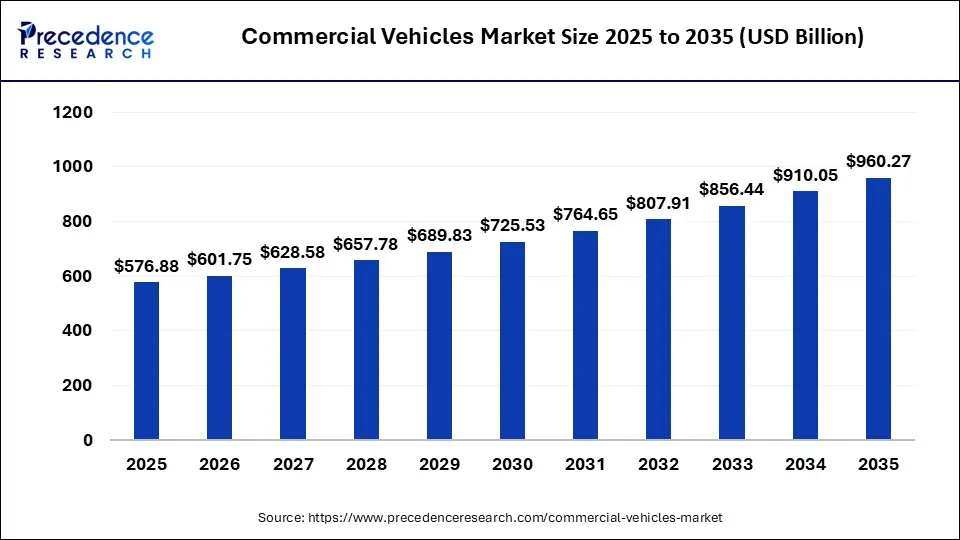
Commercial Vehicles Market Surges Toward USD 960.27 Billion by 2035
What is the Commercial Vehicles Market Size in 2026?
The global commercial vehicles market is witnessing steady expansion, driven by rising demand for efficient transportation networks, rapid urbanization, and the explosive growth of e-commerce logistics. Governments worldwide are investing heavily in infrastructure development and emission reduction policies, prompting a shift toward electric and low-emission commercial fleets. Additionally, advancements in telematics, fleet management systems, and autonomous driving technologies are reshaping the competitive landscape.
Fleet operators are increasingly prioritizing fuel efficiency, total cost of ownership (TCO), and regulatory compliance, leading to higher adoption of electric trucks, buses, and light commercial vehicles (LCVs). Emerging economies, particularly in Asia Pacific, are becoming key demand centers due to expanding industrialization and logistics needs.
What Are the Key Market Highlights?
The market is valued at approximately USD 1.2 trillion in 2024 and is projected to reach nearly USD 1.9 trillion by 2034, growing at a CAGR of around 5%.
Asia Pacific leads the market due to strong manufacturing bases and logistics expansion, particularly in China and India.
Light commercial vehicles dominate the segment due to their extensive use in last-mile delivery services.
Diesel-powered vehicles still hold a significant share, but electric commercial vehicles are rapidly gaining traction.
Key players include global automotive giants focusing on electrification, automation, and strategic partnerships.
How is Revenue Distributed Across Segments?
The market revenue is primarily segmented by vehicle type, propulsion type, and end-use application:
By Vehicle Type:
Light Commercial Vehicles (LCVs): Largest share due to urban delivery demand
Medium Commercial Vehicles (MCVs): Moderate growth driven by regional logistics
Heavy Commercial Vehicles (HCVs): Strong demand in construction and long-haul transport
By Propulsion Type:
Diesel: Dominant but declining share
Electric: Fastest-growing segment
Hybrid & Alternative Fuels: Emerging adoption
By End-Use:
Logistics & Transportation: Leading segment
Construction & Mining: Stable demand
Passenger Transport (Buses & Coaches): Growing with urban transit expansion
What Role Does AI Play in the Commercial Vehicles Market?
Artificial intelligence is transforming the commercial vehicles ecosystem by enhancing fleet efficiency, predictive maintenance, and route optimization. AI-powered telematics systems enable real-time monitoring of vehicle performance, reducing downtime and operational costs. Fleet managers are increasingly relying on AI-driven insights to improve fuel efficiency, driver safety, and asset utilization.
Moreover, AI is a critical enabler for autonomous commercial vehicles. Advanced driver-assistance systems (ADAS) and self-driving technologies are being integrated into trucks and delivery vehicles, reducing human error and improving logistics efficiency. As AI capabilities evolve, they are expected to play a central role in shaping the future of smart and connected fleets.
What Are the Key Market Growth Factors?
The market is expanding due to a combination of macroeconomic and technological drivers. The rapid growth of e-commerce has significantly increased demand for last-mile delivery vehicles, especially LCVs. Infrastructure development projects across emerging economies are boosting demand for heavy-duty trucks.
Additionally, stringent emission regulations are pushing manufacturers to innovate in electric and hybrid vehicle technologies. Government incentives and subsidies for electric commercial vehicles are further accelerating adoption. The integration of digital technologies such as IoT and AI is also enhancing fleet performance and operational efficiency.
What Opportunities and Trends Are Shaping the Market?
Is Electrification the Future of Commercial Vehicles?
Yes, electrification is emerging as a dominant trend. Governments and corporations are committing to net-zero targets, driving investments in electric trucks and buses. Battery technology advancements and charging infrastructure expansion are further supporting this transition.
How is E-commerce Influencing Market Dynamics?
E-commerce growth is reshaping logistics networks, increasing demand for agile and efficient delivery vehicles. This trend is particularly boosting the LCV segment and encouraging innovations in urban mobility solutions.
Are Autonomous Vehicles Gaining Traction?
Autonomous commercial vehicles are still in early stages but gaining momentum. Companies are investing in self-driving technologies to improve safety and reduce operational costs, especially in long-haul trucking.
Commercial Vehicles Market Dynamics
Driver: Technological Advancements in Vehicles
Technological innovation is playing a major role in driving the commercial vehicles market. Modern vehicles are increasingly equipped with advanced systems that enhance both operational efficiency and user experience. These advancements include supply chain optimization tools, predictive maintenance technologies, and AI-driven decision-making systems.
Features such as connected mobile applications, digital keys, voice commands, and personalized user interfaces are improving customer and driver experience. Additionally, technologies like automatic emergency braking, assisted parking, and driver assistance systems are enhancing safety and reducing accident risks.
Automation in functions such as doors and vehicle diagnostics, along with data-driven insights, helps businesses reduce costs and improve efficiency. Environmental benefits are also significant, as newer technologies support reduced emissions and better fuel efficiency.
Restraint: Supply Chain Disruptions
Despite strong growth drivers, supply chain disruptions remain a key challenge for the commercial vehicles market. Interruptions in the supply chain can lead to delivery delays, increased transportation costs, and operational inefficiencies, ultimately affecting customer satisfaction.
These disruptions can arise from both internal and external risks, including operational failures, cybersecurity threats, demand fluctuations, supply shortages, environmental issues, geopolitical tensions, and financial instability. Such uncertainties can significantly hinder production and distribution processes across the industry.
Opportunity: Advancements in Autonomous Driving
The development of autonomous driving technology presents a significant growth opportunity. Autonomous vehicles have the potential to greatly improve road safety by reducing accidents caused by human error, such as fatigue, distraction, and impaired judgment.
These vehicles use advanced sensors and AI systems to detect and respond to their surroundings, improving traffic flow and increasing road capacity. As the technology matures, it is expected to revolutionize mobility, making transportation safer, more efficient, and more accessible.
Segment Insights
Product Insights
Light commercial vehicles (LCVs) held the largest share of the market in 2025, driven by their widespread use in urban logistics and transportation.
For instance, in March 2025, Jupiter Electric Mobility launched the JEM TEZ electric LCV along with a new manufacturing facility in Pithampur, Indore.
Meanwhile, the heavy trucks segment is expected to grow at the fastest rate between 2026 and 2035. This growth is fueled by increasing demand for high-capacity vehicles, rising investments by OEMs, and stricter emission regulations.
In July 2025, the Indian government introduced incentives for electric trucks under the PM E-DRIVE Scheme, marking a significant step toward sustainable freight transportation.
Propulsion Type Insights
Internal combustion engine (ICE) vehicles dominated the market in 2025. However, alternative propulsion technologies are gaining momentum.
In December 2024, HORIBA India launched India’s first hydrogen internal combustion engine testing facility in Chakan, Pune, supporting the development of low-emission technologies.
The electric vehicle segment is projected to grow at the fastest pace during the forecast period. In July 2025, Neuron Energy introduced second-generation lithium-ion battery packs designed for commercial EVs, improving performance and efficiency.
End-Use Insights
The transportation sector accounted for a significant share of the market in 2025, driven by increasing demand for commercial mobility solutions.
In July 2023, the Reliable Transportation Association launched a new insurance program backed by Lloyd’s of London, aimed at improving commercial auto coverage for fleets and operators.
The logistics segment is expected to witness the fastest growth from 2026 to 2035. This is supported by the rapid expansion of e-commerce and supply chain networks.
In July 2025, Eicher Trucks and Buses introduced the Pro Plus truck series, designed to enhance efficiency and sustainability in logistics operations.
Power Source Insights
Diesel-powered vehicles dominated the market in 2025 due to their reliability and widespread infrastructure.
In March 2025, Hindustan Petroleum Corporation partnered with Tata Motors to introduce a co-branded Diesel Exhaust Fluid (DEF) to improve efficiency and emission compliance.
However, fuel cell vehicles are expected to grow at the highest rate during the forecast period. In April 2025, Hyundai unveiled the XCIENT hydrogen fuel cell truck, highlighting the shift toward zero-emission technologies.
Regional Insights
North America
North America held the largest market share in 2025 and is expected to maintain steady growth through 2035. The United States leads the region due to strong industrial activity, advanced infrastructure, and supportive government regulations.
Factors such as high adoption of commercial vehicles, robust supply chain networks, and availability of financing options contribute to market expansion. Additionally, increasing demand for long-distance freight transportation and growing investments in infrastructure are further driving growth.
Asia Pacific
Asia Pacific is projected to experience the fastest growth during the forecast period. Rapid industrialization, urbanization, and infrastructure development are key drivers in the region.
Countries such as India, China, and South Korea are investing heavily in electric mobility and sustainable transportation solutions. The region also benefits from cost-effective manufacturing, abundant labor, and strong government support for reducing carbon emissions.
The rising demand for logistics and transportation services, along with the growing popularity of shared mobility solutions, is expected to significantly boost the commercial vehicles market in Asia Pacific.
Commercial Vehicles Market Companies
- Bosch Rexroth AG
- Ashok Leyland
- Daimler
- Toyota Motor Corporation
- Volkswagen AG
- Mahindra and Mahindra
- VOLVO
- TATA Motors
- General Motors
- Golden Dragon
Segments Covered in the Report
By Product
- Light Commercial Vehicles (LCVs)
- Buses & Coaches
- Heavy Trucks
By End-use
- Industrial
- Transportation
- Others
By Propulsion Type
- IC Engine
- Electric Vehicle
By Power Source
- Gasoline
- Diesel
- HEV / PHEV
- Battery Electric Vehicle (BEV)
- Fuel Cell Vehicle
- LPG & Natural Gas
By Region
- North America
- Europe
- Asia-Pacific
- South America
- Middle East & Africa
Get Sample Link: https://www.precedenceresearch.com/sample/1062
Also Read : https://www.marketstatsinsight.com/electric-vehicle-charging-infrastructure-market/

- Corporate Wellness Market Surges Toward USD 500.09 Billion by 2035 - April 22, 2026
- Portable Medical Devices Market Surges Toward USD 221.71 Billion by 2035 - April 22, 2026
- Infant Incubator Market Set to Surpass USD 3.27 Billion by 2035 - April 22, 2026