
AI Search Engine Market to Reach USD 182.17 Billion by 2035
The global AI search engine market size was valued at USD 16.30 billion in 2025 and is projected to grow from USD 20.75 billion in 2026 to nearly USD 182.17 billion by 2035, registering a remarkable CAGR of 27.30% between 2026 and 2035. The market is expanding rapidly as businesses and consumers increasingly shift from keyword-based search to conversational, context-aware, and AI-driven discovery experiences. Advancements in natural language processing, machine learning, and generative AI are transforming how users search, retrieve, and interact with information across industries.
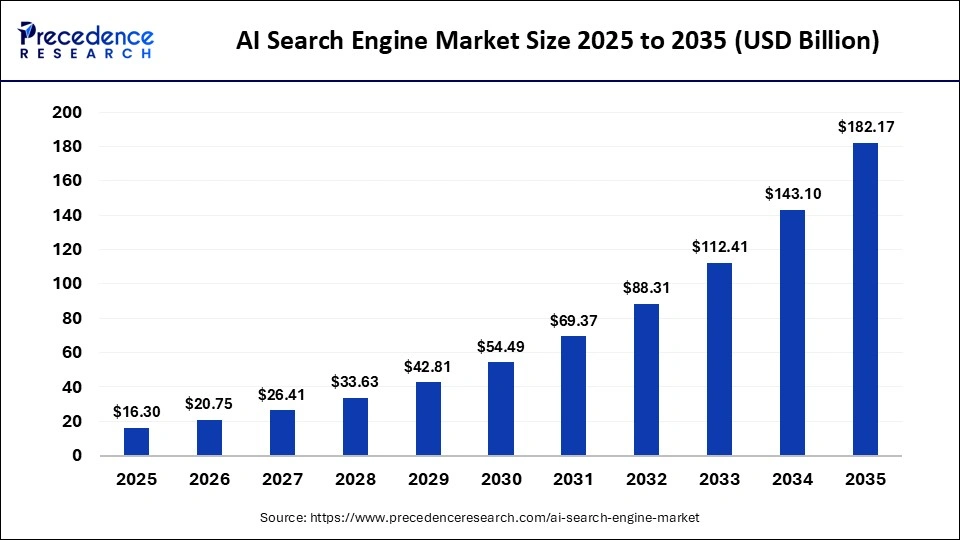
Organizations are increasingly integrating AI search capabilities into enterprise workflows, customer service platforms, internal knowledge systems, e-commerce portals, and digital assistants. As search becomes more predictive, personalized, and voice-enabled, AI search engines are becoming essential tools for both businesses and consumers.
Read Also: Applied AI in Autonomous Vehicles Market
Quick Insights
- The global AI search engine market is expected to rise from USD 20.75 billion in 2026 to USD 182.17 billion by 2035.
- North America dominated the market with a 40% revenue share in 2025.
- Asia Pacific is expected to witness the fastest growth during the forecast period.
- By technology, natural language processing held the leading share of 32% in 2025.
- By application, enterprise search accounted for 40% of total market revenue in 2025.
- By end user, enterprises held the dominant share of 60% in 2025.
- E-commerce search and consumer applications are projected to grow at the fastest pace over the next decade.
How is AI Transforming the AI Search Engine Market?
Artificial intelligence is not only powering the AI search engine market—it is fundamentally redefining search behavior itself. AI-driven search engines are moving beyond traditional keyword matching to understand intent, context, tone, and user history. Natural language processing allows search engines to interpret conversational queries, while machine learning continuously improves search relevance based on previous interactions.
Generative AI is also creating a new era of “answer engines,” where users receive direct responses instead of navigating through multiple web pages. This trend is accelerating zero-click search experiences and reshaping digital marketing strategies, content discovery, and search engine optimization practices. AI-powered enterprise search tools are helping organizations retrieve insights from internal documents, emails, databases, and cloud platforms, improving workforce productivity and decision-making.
What are the Major Growth Drivers in the AI Search Engine Market?
Why are Personalized and Context-Aware Search Experiences Becoming Essential?
Consumers increasingly expect search engines to provide highly relevant and personalized answers instantly. AI search platforms analyze browsing history, preferences, device behavior, and contextual signals to deliver faster and more accurate results. Personalized search experiences are becoming critical across industries such as retail, healthcare, finance, education, and travel.
How is Enterprise Search Driving Market Growth?
Enterprise search is emerging as one of the most valuable use cases in the market. Businesses are generating enormous volumes of structured and unstructured data, creating a growing need for intelligent search platforms that help employees quickly access internal knowledge. AI-powered enterprise search improves collaboration, streamlines workflows, reduces duplication, and enhances decision-making. Industries such as BFSI, healthcare, IT, government, and manufacturing are increasingly investing in enterprise AI search solutions.
Why are Voice Search and Conversational Interfaces Expanding So Quickly?
The widespread adoption of smartphones, voice assistants, smart speakers, and AI chatbots is accelerating the shift toward voice search and conversational interfaces. Consumers increasingly prefer natural language interactions over manual typing, especially for quick answers, local search, navigation, and e-commerce. AI-powered search assistants are becoming integral to everyday digital experiences.
Opportunity & Trends
Could Zero-Click Search Redefine the Future of Search Engines?
Yes. Zero-click search is becoming one of the most disruptive trends in the AI search engine market. Users increasingly receive answers directly within AI interfaces, reducing the need to visit external websites. This trend is changing how businesses approach SEO, digital advertising, and content marketing. Companies are now optimizing content not just for search rankings, but also for inclusion in AI-generated responses and summaries.
Why is E-Commerce Search Emerging as a Major Opportunity?
AI-powered search is transforming product discovery in e-commerce. Visual search, personalized recommendations, voice-based product search, and predictive search capabilities are improving customer engagement and increasing conversion rates. Retailers are investing heavily in AI search tools to help customers quickly find products across massive catalogs while delivering more tailored shopping experiences.
How is Open-Source AI Influencing Enterprise Search Adoption?
Open-source AI models are increasingly gaining traction in enterprise environments, especially in regulated industries such as banking, healthcare, and government. Many organizations prefer open-source search solutions because they can be deployed on-premises or in private cloud environments, offering better control over data security and compliance. Reddit discussions indicate that open-source AI adoption is accelerating rapidly among enterprises seeking lower costs and greater flexibility.
Segment Analysis
Technology Insights
The natural language processing segment dominated the market with a 32% share in 2025 because NLP is central to conversational search, contextual understanding, and voice-based interactions. NLP allows search engines to interpret human language more accurately and provide more relevant responses.
The machine learning segment accounted for 28% of the market in 2025 and is expected to grow strongly during the forecast period. Machine learning enables AI search systems to continuously improve through data analysis, user feedback, and predictive ranking models.
Reinforcement learning is also gaining traction because it allows search platforms to adapt dynamically based on user engagement and real-time interactions.
Application Insights
Enterprise search held the largest market share of 40% in 2025 due to the growing need for efficient knowledge management and data retrieval across organizations. AI enterprise search platforms are becoming critical tools for improving productivity and collaboration.
Web search accounted for 30% of the market in 2025, supported by rising demand for conversational, voice-enabled, and personalized search experiences. E-commerce search is expected to grow at the fastest rate as online retailers increasingly adopt AI-powered product discovery tools.
End-User Insights
The enterprises segment dominated the market with a 60% share in 2025 because businesses increasingly rely on AI search tools to manage large datasets, automate workflows, and enhance operational efficiency. Sectors such as healthcare, finance, retail, and government are investing heavily in AI-powered search capabilities.
The consumer segment is expected to witness the fastest growth due to rising use of AI-powered search assistants, voice interfaces, mobile applications, and personalized search tools.
Regional Analysis
Why Did North America Dominate the AI Search Engine Market?
North America accounted for 40% of global market revenue in 2025 due to its advanced digital infrastructure, widespread cloud adoption, and strong presence of major technology innovators. The region benefits from early adoption of generative AI, conversational search, and enterprise AI solutions. Major technology companies are investing heavily in AI-powered search innovation, accelerating regional market growth.
The U.S. remains the largest contributor to the regional market due to its leadership in cloud computing, AI development, enterprise software, and digital transformation initiatives.
Why is Asia Pacific the Fastest-Growing Region?
Asia Pacific is expected to expand at the fastest pace during the forecast period because of rising internet penetration, increasing smartphone adoption, government support for AI innovation, and rapid growth in e-commerce and digital platforms. Countries such as China, India, Japan, and South Korea are investing heavily in AI technologies and multilingual search platforms.
India, in particular, is emerging as a major growth market due to the rapid expansion of its startup ecosystem, growing enterprise digitization, and government-led AI innovation programs.
Leading Companies in the AI Search Engine Market
Key companies operating in the AI search engine market include:
- Google LLC
- Microsoft Corporation
- Amazon Web Services
- OpenAI
- Alphabet Inc.
Case Study: Enterprise Search Becomes a Competitive Advantage
Many enterprises are now using AI-powered search systems to unify information across emails, documents, collaboration tools, cloud platforms, and databases. This enables employees to access relevant insights faster, reducing time spent searching for information and improving decision-making. The rise of hybrid work environments is making enterprise search increasingly important as organizations seek better ways to manage distributed knowledge systems.
Get Sample Copy: https://www.precedenceresearch.com/sample/8312
For inquiries regarding discounts, bulk purchases, or customization requests, please contact us at sales@precedenceresearch.com
