Oligonucleotide Synthesis Market Size to Attain USD 12.65 Billion by 2035
What is the Oligonucleotide Synthesis Market Size in 2026?
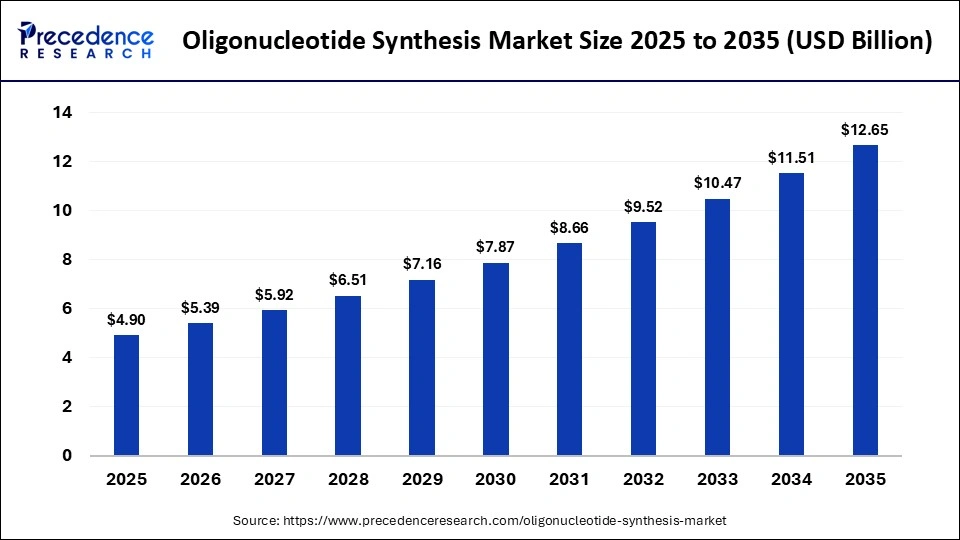
The global oligonucleotide synthesis market was calculated at USD 4.90 billion in 2025 and is projected to grow from USD 5.39 billion in 2026 to nearly USD 12.65 billion by 2035, registering a CAGR of 9.95% during the forecast period from 2026 to 2035. The market growth is primarily driven by increasing investments by pharmaceutical companies in the development of novel therapeutics, along with the rising prevalence of genetic disorders across the globe.
Key Takeaways
- North America led the market with 44% share in 2025.
- Asia Pacific is expected to rise with the highest CAGR during the forecast period.
- By type of product synthesized, the finished dosage forms segment held the largest share of the market in 2025.
- By type of product synthesized, the active pharmaceutical ingredients segment is expected to expand at a significant CAGR during the forecast period.
- By therapeutic area, the rare diseases segment held the largest share of 44% in the market in 2025.
- By therapeutic area, the cardiovascular disorders segment is expected to grow at a considerable CAGR between 2026 and 2035.
- By company size, the large and very large segment held the largest share of 70% in the market in 2025.
- By company size, the mid-sized segment is expected to rise with a robust CAGR during the forecast period.
- By scale of operation, the commercial segment held the highest share of 78% in the market and is expected to grow significantly during the forecast period.
- By type of oligonucleotide synthesized, the antisense oligonucleotide segment dominated with 58% share in the market in 2025.
- By type of oligonucleotide synthesized, the siRNA segment is expected to grow at a notable CAGR during the forecast period.
- By scale of operation, the commercial segment dominated the market in 2025.
- By end-users, the pharmaceutical/biopharmaceutical companies segment held the largest share of the market in 2025.
Market Scope
| Report Coverage | Details |
| Market Size in 2025 | USD 4.90 Billion |
| Market Size in 2026 | USD 5.39 Billion |
| Market Size by 2035 | USD 12.65 Billion |
| Market Growth Rate from 2026 to 2035 | CAGR of 9.95% |
| Dominating Region | North America |
| Fastest Growing Region | Asia Pacific |
| Base Year | 2025 |
| Forecast Period | 2026 to 2035 |
| Segments Covered | Type of Product Synthesized, Type of Product Synthesized, Company Size, Scale of Operation, Therapeutic Area, End-Users, and Region |
| Regions Covered | North America, Europe, Asia-Pacific, Latin America, and Middle East & Africa |
What is the oligonucleotide synthesis market?
The oligonucleotide synthesis market represents a significant segment of the pharmaceutical and biotechnology industry, focusing on advanced technologies used for the synthesis of oligonucleotides. Oligonucleotide synthesis is a chemical process used to create customized DNA and RNA sequences, typically in the 3’-to-5’ direction, through the phosphoramidite method. The synthesis process involves a four-step cycle comprising detritylation, coupling, capping, and oxidation.
Growing investments in research and development activities aimed at advancing oligonucleotide-based therapies are playing a major role in driving market growth. Increasing efforts by pharmaceutical and biotechnology companies to improve treatment methodologies for genetic and chronic diseases are further supporting market expansion. Additionally, the rapid growth of the global biotechnology sector is expected to create substantial opportunities for the oligonucleotide synthesis market in the coming years.
AI in the Oligonucleotide Synthesis Market
Artificial intelligence (AI) is playing a transformative role in the oligonucleotide synthesis industry by improving accuracy, efficiency, and speed across the design and manufacturing processes. AI-powered technologies are helping accelerate drug discovery, optimize clinical trials, and enhance supply chain management capabilities within the pharmaceutical and biotechnology sectors.
In recent years, oligonucleotide synthesis companies have increasingly integrated AI into their manufacturing facilities to support custom sequence design, improve process optimization, and enable real-time production monitoring. The adoption of AI-driven systems also helps reduce operational costs, minimize human errors, and ensure the production of high-quality, customized oligonucleotides, thereby supporting the growing demand for advanced therapeutics and precision medicine solutions.
Major Market Trends
- Collaborations: Numerous biopharmaceutical brands are collaborating with genetic engineering companies to develop oligonucleotide therapeutics. For instance, in April 2025, Creyon Bio, Inc., collaborated with Eli Lilly and Company. This collaboration aims at accelerating the development of novel RNA-targeted oligonucleotide therapies for the treatment of rare and common diseases.
- Business Expansions: Various pharma companies are investing rapidly in opening new oligonucleotide manufacturing capacity in different parts of the world. For instance, in April 2024, ST Pharm invested around US$ 110 million. This investment is made to open an oligonucleotide manufacturing unit in Bandola, South Korea.
- Rising Prevalence of Cancers: The growing cases of cancers in different nations, such as the U.S., India, Germany, and the UAE, have increased the demand for oligonucleotide therapeutics. According to the American Cancer Society, around 324580 cases of new breast cancer are expected to be diagnosed in the U.S. during 2026.
Regional Insights
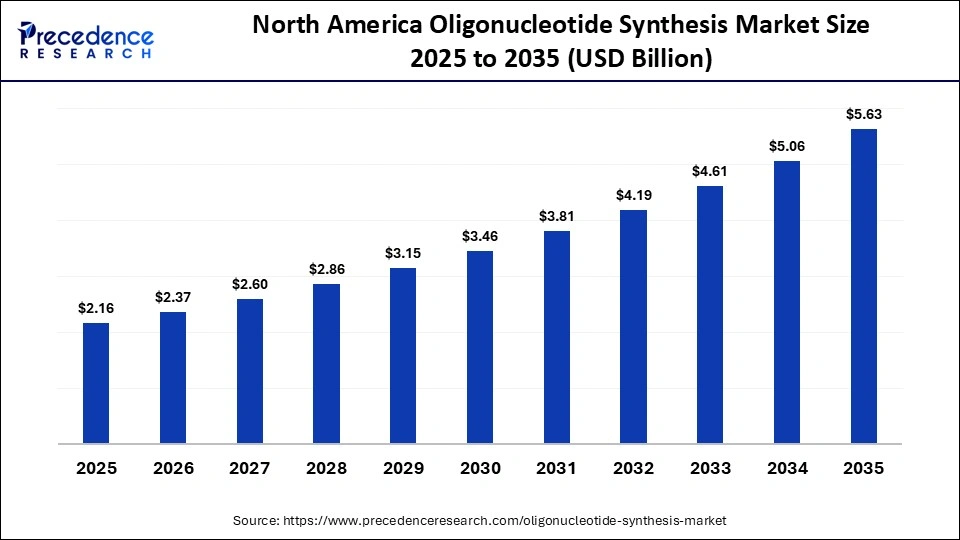
What is the North America Oligonucleotide Synthesis Market Size?