
Space Technology Market Surges Toward USD 1,081.74 Billion by 2035
What is the Space Technology Market Size in 2026?
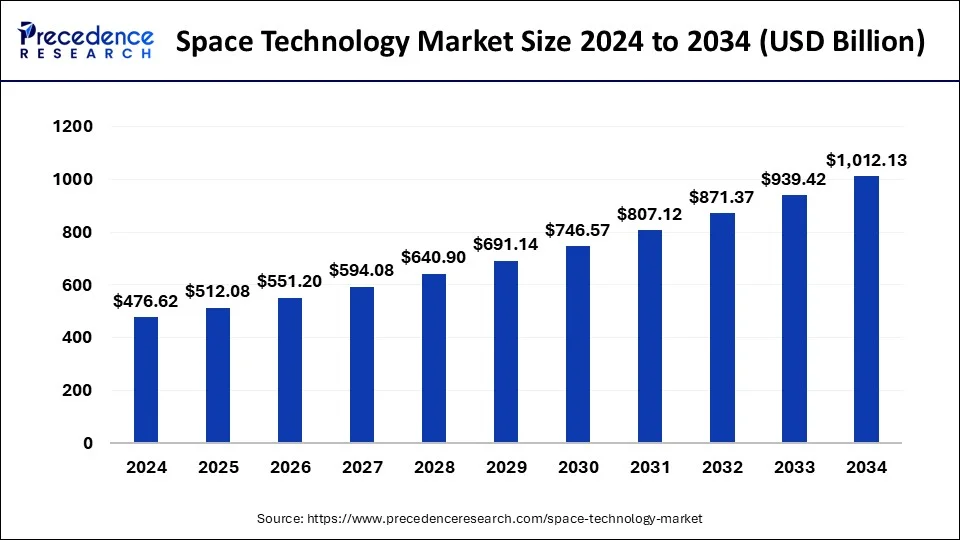
The global space technology market is entering a transformative decade, with its size projected to grow from USD 512.08 billion in 2025 to USD 1,081.74 billion by 2035, expanding at a CAGR of 7.77%. This growth is primarily driven by increasing reliance on satellite-based services for communication, navigation, and Earth observation, along with a surge in government funding and private-sector participation.
As space evolves from a government-dominated domain to a commercially vibrant ecosystem, advancements in reusable launch systems, miniaturized satellites, and deep-space exploration technologies are redefining the market landscape.
What’s Powering the Space Technology Market?
The global market was valued at USD 512.08 billion in 2025 and is expected to surpass USD 1,081.74 billion by 2035, reflecting strong long-term expansion.
North America continues to dominate the market due to heavy investments in defense and satellite infrastructure.
Satellite systems remain the leading technology segment, driven by rising demand for global connectivity and real-time data services.
Government and defense sectors account for a significant share, while commercial applications are expanding rapidly.
Key players such as SpaceX, Lockheed Martin, Airbus SE, and Northrop Grumman are shaping the competitive landscape.
How Is Artificial Intelligence Transforming the Space Technology Market?
Artificial intelligence is becoming a cornerstone of modern space operations. AI-driven analytics are enhancing satellite imaging, enabling real-time decision-making in areas such as climate monitoring, disaster response, and defense surveillance. Machine learning algorithms process massive volumes of geospatial data, unlocking actionable insights for industries ranging from agriculture to urban planning.
In addition, AI is revolutionizing spacecraft autonomy. From collision avoidance systems to predictive maintenance of satellites, AI reduces human intervention while increasing mission efficiency. As space missions become more complex, AI-powered systems are expected to play a critical role in deep-space exploration and autonomous operations.
What Are the Key Growth Drivers of the Space Technology Market?
The expansion of the space technology market is underpinned by several strong growth factors. One of the most significant is the rising demand for high-speed global connectivity, which has led to a surge in satellite deployments worldwide.
Another major driver is the increasing participation of private companies, which are reducing launch costs and accelerating innovation. Reusable rocket technology, in particular, has dramatically improved cost efficiency and accessibility to space.
Government initiatives and defense spending are also playing a crucial role, as nations prioritize space infrastructure for national security, communication, and surveillance purposes. Furthermore, advancements in robotics, miniaturization, and propulsion systems are enabling more sophisticated and cost-effective missions.
Market Scope
| Report Coverage | Details |
| Market Size in 2025 | USD 512.08 Billion |
| Market Size in 2026 | USD 551.20 Billion |
| Market Size by 2035 | USD 1,081.74 Billion |
| Growth Rate from 2026 to 2035 | CAGR of 7.77% |
| Largest Market | North America |
| Base Year | 2025 |
| Forecast Period | 2026 to 2035 |
| Segments Covered | Type, End-use, Application, and Region |
| Regions Covered | North America, Europe, Asia-Pacific, Latin America, and Middle East & Africa |
What Opportunities and Trends Are Shaping the Future of Space Technology?
Is Commercial Space Infrastructure the Next Big Opportunity?
Yes, the rise of commercial space stations, satellite-as-a-service models, and in-orbit manufacturing is opening new revenue streams. Private companies are increasingly investing in infrastructure that supports long-duration missions and space tourism.
Can Satellite Constellations Transform Global Connectivity?
Absolutely. The deployment of low Earth orbit (LEO) satellite constellations is enabling high-speed, low-latency internet worldwide, particularly in remote and underserved regions.
Will Space Become a Key Pillar of the Global Digital Economy?
The integration of space-based data with AI, IoT, and 5G technologies is positioning space as a critical enabler of the global digital ecosystem, supporting applications such as autonomous vehicles and smart cities.
Market Dynamics
Drivers
The rising demand for satellite services across industries is a major factor driving the growth of the space technology market. Satellites play a vital role in enabling communication, navigation, and Earth observation, supporting sectors such as telecommunications, agriculture, transportation, and defense. Technologies like GPS have become essential for logistics, navigation, and location-based services.
As the need for global connectivity increases, governments and businesses rely heavily on satellites for communication networks, internet access, and data transmission. Many organizations are also focusing on developing advanced launch vehicles capable of deploying multiple satellites simultaneously. For example, Indian Space Research Organisation (ISRO) has consistently strengthened its global presence through successful satellite launches.
In February 2024, ISRO successfully launched the GSLV-F14 mission, placing the INSAT-3DS meteorological satellite into geosynchronous transfer orbit, attracting global attention.
Satellite-based Earth observation is also gaining importance in agriculture, environmental monitoring, urban planning, and disaster management. These applications help organizations make data-driven decisions and optimize resource use. Overall, the increasing reliance on satellite services continues to fuel innovation, investment, and expansion in the space technology market.
Restraints
Despite rapid advancements, the high cost of developing and launching satellites remains a significant challenge. Expenses related to design, manufacturing, testing, and launch operations are substantial. Additionally, infrastructure requirements such as launch pads, ground stations, and mission control centers further increase costs.
These financial barriers make it difficult for startups and smaller companies to enter the space industry. Even governments face budget constraints that can limit investments in space programs. Although innovations like reusable rockets and streamlined manufacturing are helping reduce costs, affordability remains a key restraint.
Global government spending on space programs reached a record $117 billion in 2023, with the U.S. contributing around $73.2 billion, largely through NASA.
Opportunities
The future of the space technology market looks promising with the expansion of space exploration beyond Earth. As technology improves and costs gradually decrease, missions to the Moon, Mars, and beyond are becoming more feasible.
One major opportunity lies in establishing lunar and Martian bases for research, resource extraction, and potentially human habitation. There is growing interest in utilizing resources such as water ice and minerals to support long-term missions.
Space tourism is another emerging opportunity. Companies like SpaceX, Blue Origin, and Virgin Galactic are developing spacecraft for commercial space travel, opening the door for private individuals to experience space.
Additionally, the continued expansion of satellite applications—such as satellite internet and advanced remote sensing—will further boost innovation and investment in the industry.
Segment Insights
Type Insights
The space vehicles segment dominated the market, accounting for 66.13% of the share in 2025, and is expected to grow rapidly in the coming years. This growth is driven by increasing demand for satellite launches from both government and private organizations such as ISRO, NASA, and ESA.
Reusable rocket technology is playing a transformative role by reducing launch costs and improving efficiency. Companies like SpaceX are actively working on reusable launch systems, making space missions more economical and accessible.
Satellites remain central to space exploration, supporting applications like Earth observation, communication, and scientific research. Reliable launch systems are critical for expanding satellite networks, making advanced and durable space vehicles essential.
End-User Insights
The government segment held the largest market share (68.55%) in 2025 and is expected to maintain its dominance. This is largely due to increased investments in space programs, driven by national security concerns, disaster management needs, and technological advancement.
At the same time, commercial players are transforming the industry by introducing innovative technologies such as miniaturized satellites, lightweight rockets, and AI-enabled systems. These advancements are making space exploration more efficient and accessible.
Launch vehicles like the Falcon 9 by SpaceX and New Shepard by Blue Origin have significantly reduced launch costs and increased mission frequency.
Application Insights
The navigation and mapping segment led the market with a 21.80% share in 2025. Systems like GPS rely on satellite constellations in orbit to provide accurate positioning, timing, and navigation services worldwide. These technologies are widely used for vehicle tracking, route optimization, and asset management.
Satellite communication is another rapidly growing segment, enabling global connectivity through internet services, voice and video communication, and data transfer. It plays a crucial role in bridging the digital divide, especially in remote and underserved areas.
Satellite networks also support media broadcasting, streaming services, and content distribution, making them integral to modern communication systems.
Regional Insights
North America
North America dominated the global space technology market with a 55.67% share in 2025. The region benefits from strong investments, technological innovation, and strategic partnerships. Organizations like NASA and the Canadian Space Agency lead major research and exploration initiatives.
Private companies such as SpaceX, Blue Origin, and Lockheed Martin are driving commercial innovation in areas like satellite services, space tourism, and deep-space exploration.
Asia-Pacific
Asia-Pacific is emerging as a fast-growing hub for space technology, with countries like China, India, Japan, and South Korea investing heavily in space programs.
India, led by Indian Space Research Organisation, has gained global recognition for cost-effective missions such as Mangalyaan and Chandrayaan-3. Upcoming projects like Gaganyaan aim to further strengthen India’s position in space exploration.
The region is also seeing increased private sector participation and international collaboration, creating new opportunities for innovation and growth.
Space Technology Market Companies
- Airbus SE
- Astra Space Inc.
- Ball Corporation
- Beijing Commsat Technology Development Co. Ltd.
- Blue Origin LLC
- Boeing
- China Aerospace Science and Technology Corporation
- General Dynamics Corporation
- Hedron
- Hindustan Aeronautics Limited
- Honeywell International Inc.
- ICEYE
- Lockheed Martin Corporation
- Maxar Technologies
- Northrop Grumman Corporation
- OHB System AB
- Rocket Lab USA
- Safran S.A.
- Sierra Nevada Corporation
- SpaceX
- Thales Group
- Virgin Galactic
Segments Covered in the Report
By Type
- Space Vehicles
- Spacecraft
- Flyby Spacecraft
- Orbiter Spacecraft
- Atmospheric Spacecraft
- Lander Spacecraft
- Rover Spacecraft
- Others (Observatory Spacecraft, Penetrator Spacecraft, etc.)
- Satellites
- Weather Satellite
- Communication Satellite
- Navigation Satellites
- Earth Observation Satellite
- Astronomical Satellites
- Miniaturized Satellites
- Spacecraft
- Space Stations
- Orbital Launch Vehicles
- Deep-space communication
- In-space Propulsion
- Others (Support Infrastructure, Procedures, etc.)
By End-user
- Government
- Military
- Commercial
By Application
- Navigation & Mapping
- Meteorology
- Disaster Management
- Satellite Communication
- Satellite Television
- Remote Sensing
- Science & Engineering
- Earth Observation
- Military and National Security
- Data & Analytics
- Information Technology
- Internet Services
- Manufacturing
- Others (Space Medicine, Tele-Education, etc.)
By Region
- North America
- Europe
- Asia-Pacific
- Latin America
- Middle East and Africa
Get Sample Link: https://www.precedenceresearch.com/sample/4052
Also Read : https://www.marketstatsinsight.com/medical-device-outsourcing-market/

- Corporate Wellness Market Surges Toward USD 500.09 Billion by 2035 - April 22, 2026
- Portable Medical Devices Market Surges Toward USD 221.71 Billion by 2035 - April 22, 2026
- Infant Incubator Market Set to Surpass USD 3.27 Billion by 2035 - April 22, 2026