
Thermal Interface Materials Market Surges Toward USD 13.64 Billion by 2035
What is the Thermal Interface Materials Market Size in 2026?
The global Thermal Interface Materials (TIM) market is witnessing substantial momentum, driven by rapid advancements in high-performance electronics, electric vehicles (EVs), and data center infrastructure. As per insights from Precedence Research, the market is projected to grow significantly over the forecast period, registering a strong CAGR while reaching multi-billion-dollar valuation by 2034. Increasing demand for efficient thermal management solutions is emerging as the primary catalyst behind this growth trajectory.
The growing miniaturization of electronic devices coupled with increasing power densities has intensified the need for effective heat dissipation technologies. Thermal interface materials play a critical role in enhancing device reliability, longevity, and performance, making them indispensable across industries such as automotive, telecommunications, healthcare, and consumer electronics.

Key Market Highlights in Focus
The thermal interface materials market was valued at a substantial figure in 2024 and is expected to grow at a notable CAGR through 2034, driven by rising adoption in EV batteries and 5G infrastructure. Asia Pacific leads the global market owing to strong electronics manufacturing ecosystems, while North America remains a key innovation hub. Among product types, thermal greases dominate due to their widespread application and cost-effectiveness. Leading players such as Henkel, 3M, and Parker Hannifin continue to shape competitive dynamics through innovation and strategic partnerships.
How Is Artificial Intelligence Influencing the Thermal Interface Materials Market?
Artificial Intelligence is increasingly transforming the development and optimization of thermal interface materials. AI-driven simulations are enabling manufacturers to predict thermal conductivity, material stability, and performance under varying conditions, significantly reducing R&D timelines. This allows companies to design more efficient and customized materials tailored for specific applications such as EV batteries and high-performance computing systems.
Additionally, AI is playing a crucial role in supply chain optimization and predictive maintenance. By leveraging machine learning algorithms, manufacturers can forecast demand patterns, reduce material wastage, and enhance production efficiency. This integration of AI not only accelerates innovation but also strengthens competitive positioning in a rapidly evolving market landscape.
What Are the Key Drivers Fueling Market Expansion?
The increasing adoption of electric vehicles is a major growth driver, as battery systems require advanced thermal management to ensure safety and efficiency. The expansion of 5G networks and high-performance computing is also boosting demand for TIMs capable of handling higher heat loads. Moreover, the proliferation of consumer electronics such as smartphones, wearables, and gaming devices continues to create consistent demand.
Government initiatives promoting energy efficiency and sustainability are further encouraging the adoption of advanced thermal solutions. In addition, the rise of data centers and cloud computing infrastructure is amplifying the need for reliable heat dissipation technologies.
What Opportunities and Trends Are Shaping the Future of the Market?
Is the Shift Toward Electric Mobility Creating New Opportunities?
Yes, the rapid electrification of transportation is opening significant avenues for thermal interface materials. EV batteries generate substantial heat, and efficient thermal management is essential for performance and safety. This is driving innovation in high-performance TIMs specifically designed for automotive applications.
Are Advanced Materials Revolutionizing the Industry?
Absolutely. The emergence of phase change materials, graphene-based TIMs, and nanotechnology-enhanced solutions is transforming the market landscape. These materials offer superior thermal conductivity and reliability, making them ideal for next-generation applications.
How Is Sustainability Influencing Market Trends?
Sustainability is becoming a critical focus area, with manufacturers developing eco-friendly and recyclable thermal materials. This trend aligns with global environmental regulations and corporate sustainability goals, creating new growth opportunities.
Thermal Interface Materials Market – Product & Application Insights
Product Insights
Thermal greases and adhesives dominated the global thermal interface materials (TIMs) market in 2025, accounting for over 40% of the total value share. Their widespread use in consumer electronics and strong thermal resistance properties make them essential for maintaining optimal operating temperatures in devices. Electronic systems such as computers, industrial machinery, and automotive electronics tend to generate heat during prolonged use, and these materials help ensure smooth and reliable performance by effectively dissipating that heat.
Elastomeric pads are also gaining traction and are expected to capture a significant market share in the coming years. Their key advantage lies in ease of assembly compared to greases and adhesives. Additionally, they improve device handling and reduce the risk of increased interface resistance over time. However, their relatively high cost and limited application scope may slightly restrict their growth.
Phase change materials are projected to experience the fastest growth rate during the forecast period. This is largely due to their increasing use in construction applications, where they help regulate indoor temperatures in residential and commercial buildings. These materials absorb heat during warmer periods and release it during cooler conditions, making them effective for energy-efficient temperature management.
Thermal Gap Pad Compression Guidelines
Proper compression of thermal gap pads is critical for achieving optimal thermal performance. Compression helps eliminate air gaps and ensures better contact between surfaces, thereby reducing thermal resistance.
In general, most thermal gap pads require 10–50% compression of their original thickness to deliver optimal performance. As compression increases, air voids collapse, significantly reducing thermal resistance and improving heat transfer efficiency.
Application Insights
The computer segment held the largest market share (over 27%) in 2025, driven by increasing usage in offices and homes. Affordable desktop prices, rising internet penetration, and digital transformation especially in developing countries like India, China, and South Korea have boosted demand. Additionally, the shift toward remote work has further accelerated computer sales, upgrades, and installations.
On the other hand, the telecom sector is expected to witness substantial growth. With the expansion of digital and cashless economies, industries such as banking, e-commerce, utilities, and media heavily depend on telecom infrastructure. This growing reliance is likely to drive demand for thermal management solutions in telecom systems.
Regional Market Insights
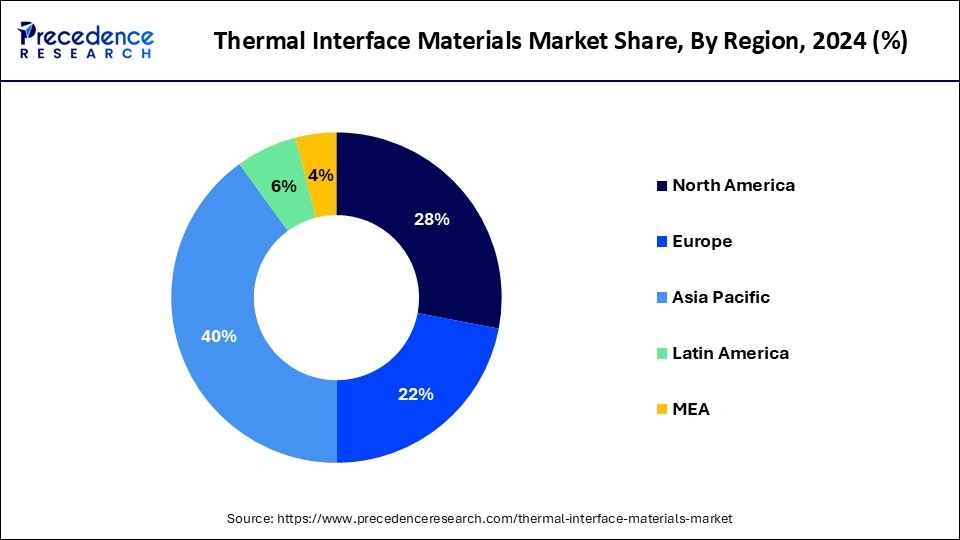
Asia Pacific
Asia Pacific led the global TIMs market in 2025, accounting for over 40% of total revenue. The region benefits from a strong manufacturing base, supportive government policies, rising household incomes, and increasing demand for electronics.
The market in Asia Pacific is projected to grow from USD 1.85 billion in 2025 to USD 5.54 billion by 2035, at a CAGR of 11.61%.
China dominates the region due to its massive electronics manufacturing ecosystem, EV battery production, and semiconductor assembly capabilities. Growth in exports and data center expansion continues to fuel demand for TIMs.
North America
North America is expected to see significant growth due to rising demand for high-performance electronics, including computing systems and consumer devices. Efficient heat dissipation has become critical as devices generate more heat, increasing the importance of thermal interface materials in improving performance and lifespan.
United States: Growth is driven by the shift toward renewable energy, along with demand from LED lighting, industrial automation, and energy storage systems.
Europe
Europe is witnessing steady growth due to increasing adoption of consumer electronics, gaming systems, and electric vehicles. Manufacturers are focusing on developing high-performance TIMs that comply with strict regulatory standards.
Germany leads the region, supported by its strong automotive sector, EV ecosystem, and industrial electronics manufacturing.
Latin America
Latin America is an emerging market with growth driven by advancements in electronics assembly, automotive production, and renewable energy projects. Increasing digitalization and telecom development are creating new opportunities.
Brazil stands out as the leading country due to its automotive industry and growing investments in electronics and renewable energy.
Middle East & Africa
This region is experiencing rapid growth due to investments in infrastructure, including power systems, data centers, and industrial development. The demand for efficient thermal management solutions is rising across energy, telecom, and industrial sectors.
UAE leads the region, driven by smart city initiatives, data center expansion, and renewable energy investments.
Thermal Interface Materials Market Companies
- Dow Corning Company
- The 3M Company
- Honeywell International, Inc .
- Parker Chomerics
- Indium Corporation
- Henkel AG & Co, KGaA
- Momentive Performance Materials, Inc.
- GrafTech International Ltd.
- Laird Technologies, Inc.
- Fuji Polymer Industries Co., Ltd.
- AIM Specialty Materials
- Shin-Etsu Chemical Co. Ltd.
- Wakefield-Vette, Inc.
- DK Thermal
- AOS Thermal Compounds LLC
- SEMIKRON
Segments Covered in the Report
By Product
- Elastomeric Pads
- Tapes & Films
- Greases & Adhesives
- Metal Based
- Phase Change Materials
- Others
By Application
- Computer
- Telecom
- Medical Devices
- Consumer Durables
- Industry Machinery
- Automotive Electronics
- Others
By Region
- North America
- Asia Pacific
- Europe
- Latin America
- Middle East and Africa
Get Sample Link: https://www.precedenceresearch.com/sample/1139
Also Read : https://www.marketstatsinsight.com/medical-device-outsourcing-market/

- Corporate Wellness Market Surges Toward USD 500.09 Billion by 2035 - April 22, 2026
- Portable Medical Devices Market Surges Toward USD 221.71 Billion by 2035 - April 22, 2026
- Infant Incubator Market Set to Surpass USD 3.27 Billion by 2035 - April 22, 2026