
Synthetic Biology Market Size to Surpass USD 252.42 Billion by 2035
The global synthetic biology market was valued at USD 24.58 billion in 2025 and is projected to grow from USD 30.29 billion in 2026 to approximately USD 252.42 billion by 2035, registering a CAGR of 26.23% during the forecast period. The market’s growth is primarily driven by the increasing demand for sustainable bio-based products, advancements in DNA sequencing and synthesis technologies, and the expanding adoption of synthetic biology across healthcare, agriculture, and industrial applications.
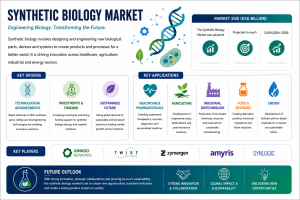
Synthetic Biology Market Key Highlights
- North America led the global synthetic biology market in 2025, capturing the largest revenue share due to its advanced biotechnology ecosystem, strong research capabilities, and substantial investments in life sciences.
- Asia Pacific is expected to experience the fastest growth throughout the forecast period, supported by rising biotechnology investments, expanding healthcare infrastructure, and increasing government initiatives promoting scientific innovation.
- Based on technology, the PCR (Polymerase Chain Reaction) segment emerged as the dominant category in 2025, accounting for a significant share of the market owing to its widespread use in molecular diagnostics, genetic analysis, and research applications.
- By product type, the oligonucleotides, oligo pools, and synthetic DNA segment held the leading market position in 2025, driven by growing demand for gene synthesis, genome engineering, and synthetic biology research activities.
- In terms of application, the healthcare sector remained the largest contributor to market revenue, fueled by increasing adoption of gene therapies, personalized medicine, advanced diagnostics, and drug discovery solutions.
- Among end users, pharmaceutical and biotechnology companies accounted for the highest revenue share in 2025, reflecting their substantial investments in research and development, therapeutic innovation, and commercialization of synthetic biology technologies
Why Businesses and Researchers Are Investing in Synthetic Biology
Synthetic biology has become a major focus for businesses, research institutions, and investors due to its ability to create innovative solutions across healthcare, agriculture, manufacturing, and environmental sustainability. Unlike traditional biotechnology, synthetic biology enables scientists to design and engineer biological systems with greater precision, opening the door to entirely new products and production methods.
Businesses are investing in synthetic biology to improve efficiency, reduce operational costs, and develop sustainable alternatives to conventional manufacturing processes. Industries such as pharmaceuticals, chemicals, food production, and agriculture are leveraging engineered biological systems to create high-value products while minimizing environmental impact. These innovations help companies meet consumer demand for sustainable products and comply with increasingly stringent environmental regulations.
Get Sample: https://www.precedenceresearch.com/sample/2862
Transforming Agriculture with Smart Biological Solutions
Agriculture is facing unprecedented challenges, including climate change, water scarcity, declining soil quality, and a growing global population. To address these concerns, synthetic biology is introducing smart biological solutions that improve agricultural productivity while promoting sustainability.
Scientists are engineering crops with enhanced resistance to pests, diseases, drought, and extreme weather conditions. These improvements help farmers maintain consistent yields even in challenging environments, reducing the risk of crop losses and improving food security. Bioengineered crops can also be designed to require fewer chemical fertilizers and pesticides, lowering production costs and reducing environmental damage.
What is Driving the Synthetic Biology Market?
- Rapid Advancements in Gene Editing Technologies: Innovations such as CRISPR-Cas systems, TALENs, and zinc-finger nucleases have dramatically improved the accuracy and efficiency of genome engineering. These technologies allow researchers to modify DNA with unprecedented precision, enabling the development of novel therapies, engineered microorganisms, and genetically enhanced crops.
- Declining Cost of DNA Sequencing and Synthesis: The cost of sequencing and synthesizing DNA has decreased significantly over the past decade. This affordability has expanded access to synthetic biology tools, enabling startups, research institutions, and pharmaceutical companies to accelerate innovation and product development.
- Increasing Demand for Personalized Medicine: Synthetic biology is playing a critical role in the advancement of precision medicine. Engineered cells, gene therapies, and synthetic biological pathways are helping researchers develop treatments tailored to individual genetic profiles, improving therapeutic outcomes and reducing side effects.
- Growing Investment from Public and Private Sectors; Governments worldwide are funding synthetic biology initiatives to strengthen healthcare infrastructure, promote bio-manufacturing, and support scientific innovation. Venture capital investments and strategic partnerships are also fueling commercialization efforts across the industry.
- AI Integration Accelerating Biological Design: Artificial intelligence is transforming synthetic biology by optimizing the design-build-test-learn (DBTL) cycle. Machine learning algorithms help predict biological outcomes, design genetic circuits, and reduce experimentation time, significantly lowering R&D costs and improving efficiency.
Key Technologies Shaping the Market
- Polymerase Chain Reaction (PCR): PCR remains one of the most widely used technologies in synthetic biology. It enables rapid DNA amplification and supports gene cloning, genetic engineering, and molecular diagnostics applications. PCR represented the largest technology segment in the market.
- Next-Generation Sequencing (NGS): NGS technologies facilitate large-scale genomic analysis, allowing researchers to understand complex biological systems and accelerate synthetic biology research.
- Genome Editing Platforms: Advanced genome engineering tools continue to drive innovation in therapeutic development, agricultural biotechnology, and industrial microbiology.
Read More: Neuroimmunology Market
Success Stories Real-World Applications of Synthetic Biology
Synthetic biology is no longer limited to research laboratories; it is already delivering practical solutions across various industries. Several successful applications demonstrate the technology’s ability to solve real-world challenges and create commercial value.
One notable success story is the development of advanced biologically produced medicines. Engineered microorganisms are being used to manufacture complex therapeutic compounds that were previously difficult or expensive to produce through conventional methods. These innovations have improved access to important treatments while reducing manufacturing costs.
Another significant application can be seen in vaccine development. Synthetic biology platforms have enabled researchers to accelerate vaccine design and production processes, helping improve responses to emerging health threats. The ability to rapidly engineer biological systems has demonstrated the value of synthetic biology in modern healthcare.
Regional Analysis
- North America: North America continues to lead the synthetic biology market due to its strong biotechnology ecosystem, advanced research infrastructure, and significant investment in innovation. The presence of leading biotechnology companies, world-class research institutions, and supportive government initiatives contributes to the region’s dominant position.
- Europe: Europe remains a major center for synthetic biology innovation, supported by extensive research funding and sustainability-focused policies. The region is actively promoting bio-based manufacturing and environmental biotechnology solutions, creating favorable conditions for market growth.
- Asia Pacific: Asia Pacific is expected to witness the fastest growth in the coming years. Rapid industrialization, increasing healthcare investments, expanding biotechnology sectors, and government support for life sciences are driving market expansion across countries such as China, India, Japan, and South Korea.
- Latin America: Latin America is gradually strengthening its presence in the synthetic biology industry through investments in biotechnology research and agricultural modernization. Growing awareness of sustainable farming and bio-based production methods is expected to support future growth.
- Middle East and Africa: The Middle East and Africa region is showing increasing interest in biotechnology and life sciences. Expanding healthcare infrastructure, scientific research initiatives, and investments in innovation are creating new opportunities for synthetic biology applications across the region.
Future Innovations Expected to Transform the Industry
The future of synthetic biology is filled with exciting possibilities as technological advancements continue to expand the boundaries of biological engineering. Researchers are developing increasingly sophisticated tools that will enable faster innovation and broader commercial adoption.
One area expected to experience significant growth is artificial intelligence-driven biological design. AI systems are becoming more capable of predicting biological behaviors, optimizing genetic constructs, and accelerating the discovery of new products and therapies. This integration of AI and synthetic biology will significantly reduce research timelines and development costs.
You can place an order or ask any questions. Please feel free to contact us at sales@precedenceresearch.com |+1 804 441 9344
