
Aluminum Foil Packaging Market Size, Trends and Growth Forecast 2026 to 2035
The global aluminum foil packaging market is entering a new phase of expansion as industries increasingly prioritize product safety, sustainability, convenience, and extended shelf life. Aluminum foil has evolved far beyond its traditional role in household kitchens and now serves as one of the most critical materials in modern packaging systems. Food manufacturers, pharmaceutical companies, cosmetic brands, and e-commerce businesses are relying on aluminum foil packaging to preserve quality, maintain freshness, and meet strict regulatory requirements.
According to recent industry analysis, the global aluminum foil packaging market size was valued at USD 51.62 billion in 2025 and is projected to grow from USD 53.75 billion in 2026 to approximately USD 79.96 billion by 2035, registering a compound annual growth rate (CAGR) of 4.47% between 2026 and 2035.
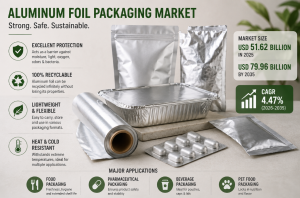
Aluminum Foil Packaging Market Overview
Aluminum foil packaging refers to packaging products manufactured using thin sheets of aluminum that provide an exceptional barrier against moisture, oxygen, light, odors, bacteria, and contaminants. Its versatility allows it to be converted into multiple packaging formats, including pouches, blister packs, wraps, containers, closures, and trays.
The increasing emphasis on food safety, pharmaceutical protection, and environmentally responsible packaging has accelerated the adoption of aluminum foil worldwide. Unlike many conventional packaging materials, aluminum foil offers both superior functionality and excellent recyclability, making it attractive to manufacturers seeking sustainable alternatives. As consumer preferences shift toward convenient and premium products, aluminum foil packaging continues to gain importance across numerous industries.
Market Size and Forecast
| Market Indicator | Value |
|---|---|
| Market Size (2025) | USD 51.62 Billion |
| Market Size (2026) | USD 53.75 Billion |
| Forecast Value (2035) | USD 79.96 Billion |
| CAGR (2026–2035) | 4.47% |
| Largest Regional Market | Asia Pacific |
| Base Year | 2025 |
| Forecast Period | 2026–2035 |
This growth trajectory reflects the increasing need for packaging solutions capable of preserving product quality while addressing sustainability concerns.
Why Aluminum Foil Packaging Is Becoming Essential
One of the primary reasons for the widespread adoption of aluminum foil packaging is its unmatched protective capability. It creates a nearly impenetrable barrier against environmental factors that compromise product quality.
Aluminum foil effectively blocks oxygen, moisture, ultraviolet radiation, and microbial contamination. This barrier performance significantly extends shelf life and reduces food waste. In pharmaceutical applications, it ensures medicine stability and prevents degradation caused by humidity and temperature fluctuations.
Its lightweight structure also reduces transportation costs while improving handling efficiency. The material can be molded into various shapes without compromising strength, making it suitable for both flexible and rigid packaging applications.
Moreover, aluminum is infinitely recyclable without losing its inherent properties. This characteristic aligns strongly with global sustainability initiatives and circular economy objectives.
Key Factors Driving Market Growth
The food industry remains the most influential growth engine behind aluminum foil packaging demand. Urban lifestyles, changing eating habits, and increasing reliance on convenience foods have substantially increased the consumption of packaged products.
Ready-to-eat meals, frozen foods, dairy products, snacks, confectionery items, and takeaway meals all require packaging capable of maintaining freshness and ensuring food safety throughout distribution.
The pharmaceutical industry is another major contributor to market expansion. Blister packs, strip packs, sachets, and cold-chain solutions rely heavily on aluminum foil due to its ability to preserve drug efficacy and comply with stringent healthcare regulations.
The rapid growth of e-commerce has further strengthened demand. Longer transportation distances and increasingly complex supply chains require packaging that can withstand handling while protecting products from environmental exposure.
Consumers are also placing greater importance on sustainable packaging. Brands seeking to reduce plastic dependence are increasingly incorporating recyclable aluminum-based materials into their packaging portfolios.
The Impact of Artificial Intelligence on Aluminum Foil Packaging
Artificial intelligence is transforming the aluminum foil packaging landscape by improving efficiency and reducing waste throughout manufacturing operations.
AI-powered image recognition systems are capable of identifying microscopic defects such as perforations, uneven coatings, and micro-cracks during production. This enables manufacturers to maintain consistent quality standards while minimizing defective output.
Machine learning algorithms optimize production parameters by automatically adjusting settings related to foil thickness, lamination, and embossing. These systems improve uniformity and reduce material consumption.
Predictive maintenance solutions powered by AI monitor equipment performance to identify potential failures before they occur, minimizing downtime and increasing operational efficiency.
AI also enhances supply chain visibility by forecasting demand patterns and optimizing inventory management, enabling manufacturers to respond more effectively to changing market conditions.
Sustainability Trends Reshaping the Industry
Environmental responsibility has become one of the defining themes influencing packaging innovation worldwide.
Aluminum foil possesses a significant advantage because it can be recycled repeatedly without losing its protective properties. Manufacturers are increasingly emphasizing closed-loop recycling systems and investing in technologies that improve aluminum recovery rates.
Research efforts are focusing on ultra-thin foil structures capable of delivering equivalent barrier performance while reducing raw material usage. Energy-efficient production methods and renewable energy integration are further helping companies lower their environmental footprint.
Global regulatory frameworks aimed at reducing plastic waste are accelerating the transition toward recyclable packaging solutions, positioning aluminum foil as a favorable alternative.
