
In Vitro Diagnostics Market Size to Attain USD 252.42 Billion by 2035
The global in vitro diagnostics (IVD) market was valued at USD 104.01 billion in 2025 and is projected to reach approximately USD 135.76 billion by 2035, expanding at a CAGR of 2.7% from 2026 to 2035. Market growth is primarily driven by the increasing need for early disease detection, rising awareness of preventive healthcare, and the growing adoption of advanced diagnostic technologies that enable accurate and timely diagnosis of various medical conditions.
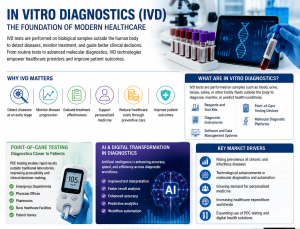
What is In Vitro Diagnostics and Why Does it Matter?
In Vitro Diagnostics (IVD) refers to medical tests performed on samples such as blood, urine, tissue, or other body fluids outside the human body. These tests help healthcare professionals detect diseases, monitor health conditions, and make informed treatment decisions. IVD products include diagnostic instruments, reagents, software, and testing kits used in hospitals, laboratories, clinics, and even home settings.
IVD plays a crucial role in modern healthcare because it enables early disease detection and supports preventive care. Accurate diagnostic information helps physicians identify health problems before symptoms become severe, allowing for timely intervention and improved patient outcomes. From diagnosing infectious diseases and cancer to monitoring diabetes and cardiovascular conditions, IVD technologies have become an essential part of healthcare systems worldwide.
Get Sample: https://www.precedenceresearch.com/sample/1130
The Growing Demand for Automated Laboratory Solutions
Laboratory automation is becoming a key driver of growth in the IVD market. Healthcare facilities are handling increasing volumes of diagnostic tests while facing pressure to improve efficiency, accuracy, and turnaround times. Automated laboratory systems help address these challenges by reducing manual processes and streamlining workflows.
Automation improves productivity by enabling laboratories to process a larger number of samples with minimal human intervention. It also reduces the risk of errors, enhances consistency, and supports higher-quality diagnostic outcomes. Advanced automated analyzers can perform multiple tests simultaneously, helping laboratories meet growing demand while maintaining operational efficiency.
How Digital Healthcare is Supporting Diagnostic Innovation
Digital healthcare technologies are reshaping the way diagnostic services are delivered and managed. Electronic health records (EHRs), telemedicine platforms, cloud-based systems, and mobile health applications are improving access to diagnostic information and enabling more connected healthcare experiences.
Digital tools allow healthcare providers to share test results quickly, monitor patient health remotely, and integrate diagnostic data into clinical decision-making processes. This connectivity supports faster diagnosis and more personalized treatment plans.
How Healthcare Providers Benefit from Advanced Diagnostics
Advanced diagnostic technologies are transforming healthcare by enabling faster, more accurate, and more efficient disease detection. Healthcare providers rely on modern diagnostic tools to identify diseases at earlier stages, allowing timely treatment and improving patient outcomes. Accurate diagnostic results help physicians make informed clinical decisions, reduce the likelihood of misdiagnosis, and develop personalized treatment plans based on individual patient needs.
Advanced diagnostics also improve workflow efficiency within hospitals and laboratories. Automated testing systems, molecular diagnostics, and digital platforms reduce manual processes, shorten turnaround times, and increase testing capacity. This allows healthcare professionals to focus more on patient care while maintaining high standards of diagnostic accuracy.
Market Segmentation Analysis
By Product
- Reagents and Consumables: This segment accounts for the largest share of the IVD market due to the recurring need for testing reagents across healthcare facilities. Continuous product innovation and expanding test menus are driving segment growth.
- Instruments: Diagnostic instruments include analyzers, sequencing systems, and automated laboratory platforms. Technological advancements and laboratory automation are fueling demand for advanced instruments.
By Technology
- Clinical Chemistry
- Immunodiagnostics
- Molecular Diagnostics
- Hematology
- Coagulation Testing
- Microbiology
- Tissue Diagnostics
Among these, molecular diagnostics continues to experience the fastest growth due to its ability to provide highly accurate and personalized diagnostic insights.
By Application
- Infectious Disease Testing: This segment remains a major contributor due to the ongoing need for rapid pathogen detection and disease surveillance.
- Oncology Diagnostics: The growing global cancer burden and increasing adoption of precision medicine are driving demand for advanced cancer diagnostics. Liquid biopsy and biomarker testing are gaining significant attention.
- Diabetes Testing: Rising diabetes prevalence worldwide continues to create strong demand for blood glucose monitoring and related diagnostic solutions.
Regional Insights
North America
North America dominates the global IVD market due to:
- Advanced healthcare infrastructure
- Strong reimbursement systems
- High adoption of innovative technologies
- Presence of major market players
The United States remains the largest contributor to regional growth.
Europe
Europe represents a mature diagnostics market with strong demand for molecular testing, cancer screening, and personalized medicine.
Asia-Pacific
Asia-Pacific is expected to witness the fastest growth during the forecast period due to:
- Expanding healthcare infrastructure
- Growing healthcare expenditure
- Large patient populations
- Rising awareness of preventive healthcare
Countries such as China, India, and Japan are driving regional expansion.
Latin America and Middle East & Africa
Improving healthcare access and increasing investments in diagnostic infrastructure are creating new growth opportunities across emerging markets.
Competitive Landscape
The IVD market is highly competitive, with leading companies focusing on innovation, acquisitions, strategic partnerships, and product development.
Major Players Operating in the Market
- Roche Diagnostics
- Abbott Laboratories
- Siemens Healthineers
- Thermo Fisher Scientific
- Danaher Corporation
- Bio-Rad Laboratories
- bioMérieux
- QIAGEN
- Sysmex Corporation
- Becton, Dickinson and Company (BD)
- QuidelOrtho Corporation
- Quest Diagnostics
These companies continue to invest heavily in molecular diagnostics, AI-powered testing platforms, next-generation sequencing technologies, and decentralized diagnostic solutions.
Read More: Synthetic Biology Market
Emerging Trends Transforming the Market
Growth of Molecular Diagnostics
Molecular diagnostics has become one of the fastest-growing segments within the IVD industry. These technologies detect genetic material associated with diseases and provide highly accurate diagnostic results.
Applications include:
- Cancer diagnostics
- Infectious disease detection
- Genetic disorder screening
- Prenatal testing
- Pharmacogenomics
The increasing adoption of PCR, digital PCR, and NGS technologies is accelerating the growth of molecular diagnostics worldwide.
Rising Adoption of Point-of-Care Testing (POCT)
Point-of-care diagnostics allow healthcare providers to perform tests near patients, delivering rapid results and enabling immediate clinical decisions.
Benefits include:
- Faster diagnosis
- Reduced laboratory dependency
- Improved patient convenience
- Enhanced emergency care
The demand for portable and easy-to-use diagnostic devices continues to increase across hospitals, clinics, pharmacies, and home-care settings.
The Future of Smart and Connected Diagnostic Devices
Smart and connected diagnostic devices are expected to play a major role in the future of healthcare. These devices combine advanced diagnostic technologies with digital connectivity, enabling real-time data collection, analysis, and sharing. By connecting diagnostic tools to cloud-based platforms and healthcare networks, physicians can access patient information more quickly and make faster treatment decisions.
The growing adoption of the Internet of Medical Things (IoMT), artificial intelligence (AI), and wearable health technologies is driving innovation in connected diagnostics. Smart devices can continuously monitor health conditions, track disease progression, and automatically transmit results to healthcare providers. This improves patient monitoring, especially for individuals with chronic diseases such as diabetes, cardiovascular disorders, and respiratory conditions.
You can place an order or ask any questions. Please feel free to contact us at sales@precedenceresearch.com |+1 804 441 9344
