
AI in Pharma Supply Chain Market Size to Reach USD 24.69 Billion by 2035
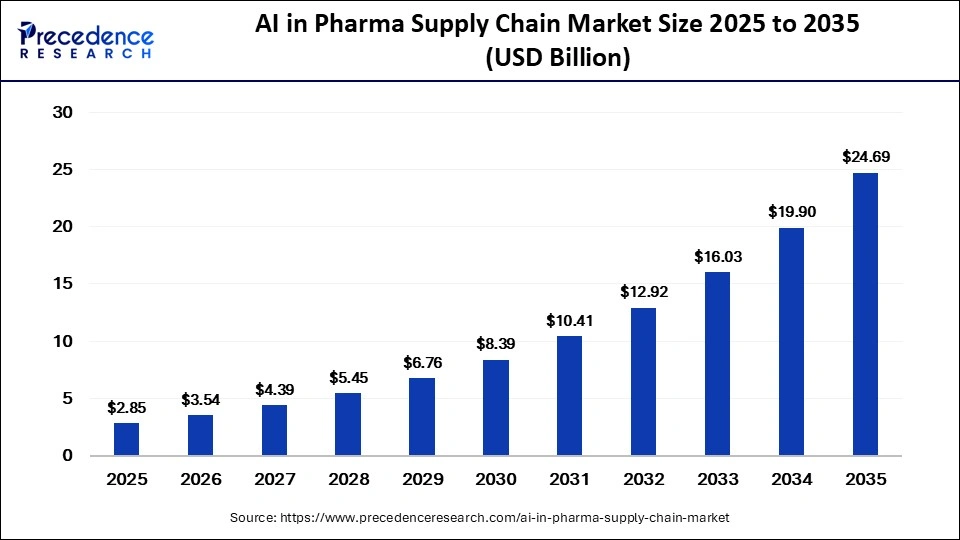
The global AI in pharma supply chain market is projected to grow from USD 3.54 billion in 2026 to USD 24.69 billion by 2035 at a CAGR of 24.10%. Explore market trends, drivers, regional insights, leading companies, AI innovations, and future opportunities transforming pharmaceutical supply chains.
Introduction
The pharmaceutical industry is undergoing a major digital transformation as companies increasingly adopt artificial intelligence to optimize supply chain operations, improve forecasting accuracy, reduce drug shortages, and strengthen logistics efficiency. The growing complexity of global pharmaceutical supply networks, combined with rising demand for temperature-sensitive biologics, vaccines, and specialty medicines, is accelerating investments in AI-powered supply chain technologies worldwide.
AI technologies such as machine learning, predictive analytics, computer vision, natural language processing (NLP), and robotic process automation (RPA) are enabling pharmaceutical companies to build more intelligent, responsive, and resilient supply chains. These solutions help manufacturers improve inventory management, optimize transportation routes, monitor cold chain conditions, and enhance regulatory compliance.
According to Precedence Research, the global AI in pharma supply chain market size was valued at USD 2.85 billion in 2025 and is expected to increase from USD 3.54 billion in 2026 to approximately USD 24.69 billion by 2035, expanding at a CAGR of 24.10% during the forecast period.
Read Also: Multilingual LLM Market
AI in Pharma Supply Chain Market Overview
AI in pharma supply chain refers to the integration of artificial intelligence technologies into pharmaceutical manufacturing, inventory management, logistics, procurement, warehouse automation, and distribution operations.
AI systems help pharmaceutical organizations predict demand fluctuations, reduce stockouts, automate repetitive tasks, monitor cold chain logistics, and identify supply chain disruptions in real time. Modern AI-driven supply chains are increasingly transitioning from reactive manual systems to autonomous, data-driven operational networks capable of self-optimization.
The increasing use of biologics, personalized medicines, and globalized pharmaceutical distribution networks is creating strong demand for intelligent supply chain management solutions.
Key Market Statistics
Major Market Highlights
- The AI in pharma supply chain market is projected to grow at a CAGR of 24.10% from 2026 to 2035.
- North America accounted for 41% of global market share in 2025.
- Cloud-based deployment dominated the market with 72% share in 2025.
- Machine learning represented 30% of technology segment share in 2025.
- Demand forecasting accounted for 24% of application demand in 2025.
- Pharmaceutical manufacturers contributed 42% of end-use market share in 2025.
- Biotechnology companies are projected to grow at the fastest CAGR of 28.5% through 2035.
- Asia-Pacific is expected to witness the fastest regional CAGR of 29.5% during the forecast period.
- AI-driven warehouse automation is projected to expand rapidly because of increasing demand for cold chain monitoring and logistics optimization.
Key Market Drivers
Rising Need for Accurate Demand Forecasting
Demand forecasting has become one of the most critical applications of AI in pharmaceutical supply chains.
The pharmaceutical industry often experiences fluctuating demand for essential medicines, vaccines, and biologics. AI-powered predictive analytics systems help manufacturers forecast market demand more accurately by analyzing historical sales, epidemiological data, supplier capacity, and geopolitical risks. According to market insights, AI can reduce forecasting errors by 20–35%, significantly improving inventory availability and minimizing drug shortages.
This capability is becoming increasingly important as pharmaceutical supply chains grow more global and interconnected.
Expansion of Cold Chain Logistics
The rapid growth of biologics, vaccines, and temperature-sensitive therapies is increasing the complexity of pharmaceutical logistics operations.
AI-enabled cold chain monitoring systems use IoT sensors, machine learning algorithms, and predictive analytics to monitor temperature fluctuations in real time and prevent spoilage during transportation and storage. AI-powered logistics systems also optimize delivery routes and improve supply chain visibility for sensitive pharmaceutical products.
The increasing global distribution of biologics and personalized therapies continues to accelerate demand for intelligent cold chain solutions.
Growing Focus on Supply Chain Resilience
Recent global disruptions, including pandemics, geopolitical tensions, and transportation bottlenecks, have highlighted vulnerabilities within pharmaceutical supply chains.
AI technologies enable pharmaceutical companies to build resilient supply chain ecosystems capable of detecting disruptions, identifying alternative suppliers, and rerouting shipments in real time. Advanced AI systems increasingly function as “self-healing” supply chains that automatically respond to operational challenges.
Supply chain resilience has become a strategic priority for pharmaceutical manufacturers worldwide.
Increasing Adoption of Warehouse Automation
AI-powered robotics and automation systems are transforming pharmaceutical warehouses and distribution centers.
Warehouse automation technologies improve inventory tracking, reduce manual labor, accelerate order fulfillment, and support regulatory compliance. AI-enabled systems also help optimize storage conditions for pharmaceutical products requiring strict environmental controls.
The rise of automated pharmaceutical fulfillment centers is expected to significantly support future market growth.
Impact of Artificial Intelligence on Pharma Supply Chains
Artificial intelligence is fundamentally reshaping pharmaceutical supply chains through automation, predictive intelligence, and real-time operational optimization.
Machine learning algorithms analyze massive datasets to forecast demand, monitor supplier risks, optimize procurement, and improve inventory management. Natural language processing technologies help process procurement documents, supplier reports, and compliance records more efficiently. AI-driven computer vision systems support automated quality inspection and warehouse monitoring.
Industry experts increasingly view AI as a “force multiplier” rather than a replacement for human decision-making. Discussions within supply chain communities emphasize that AI performs best in high-volume, repetitive tasks such as forecasting, paperwork automation, inventory analysis, and logistics optimization, while human expertise remains critical for strategic decisions and crisis management.
Market Trends
Rising Adoption of Agentic AI Systems
The market is witnessing growing adoption of intelligent AI agents capable of autonomously managing inventory replenishment, logistics optimization, and shipment routing.
Unlike traditional predictive AI systems that only generate recommendations, agentic AI technologies increasingly execute operational actions independently within predefined governance frameworks.
This trend is expected to significantly transform pharmaceutical logistics and supply chain automation over the next decade.
Integration of AI with Blockchain Technology
Pharmaceutical companies are increasingly combining AI with blockchain technologies to improve transparency, traceability, and counterfeit prevention.
Blockchain-enabled supply chains provide secure end-to-end tracking of pharmaceutical products, while AI systems analyze transactional data to identify anomalies and improve compliance monitoring.
The growing concern regarding counterfeit medicines is accelerating investments in traceable pharmaceutical supply chains.
Expansion of Digital Twin Technologies
Digital twin technologies are gaining strong momentum across pharmaceutical supply chain operations.
Companies increasingly create virtual replicas of supply chain networks to simulate disruptions, optimize inventory strategies, and improve operational planning in risk-free digital environments.
Digital twins are becoming valuable tools for supply chain resilience and scenario analysis.
Increasing Use of Cloud-Based AI Platforms
Cloud-based deployment held 72% market share in 2025 because cloud infrastructure offers scalability, centralized data integration, and cost efficiency.
Pharmaceutical organizations increasingly rely on cloud-native AI platforms to support real-time visibility, collaboration, and enterprise-wide supply chain management.
Market Restraints
Fragmented and Poor-Quality Data
Fragmented data remains one of the biggest barriers to effective AI implementation in pharmaceutical supply chains.
Many organizations continue to rely on siloed legacy systems with inconsistent or incomplete data, making it difficult to train AI models accurately. Industry professionals frequently highlight that poor data quality can significantly reduce AI effectiveness.
Data governance and integration remain critical challenges for pharmaceutical enterprises.
Regulatory and Compliance Complexity
Pharmaceutical supply chains operate under highly regulated environments involving strict compliance requirements related to safety, quality control, and traceability.
AI systems must comply with evolving regulatory frameworks while ensuring transparency, auditability, and operational reliability.
Shortage of Skilled AI Professionals
The pharmaceutical sector faces a growing shortage of professionals capable of understanding both AI technologies and pharmaceutical supply chain operations.
This talent gap may slow AI adoption across some organizations, particularly small and mid-sized enterprises.
High Initial Investment Costs
Deploying AI infrastructure, cloud platforms, IoT systems, robotics, and advanced analytics technologies often requires substantial capital investment.
Smaller pharmaceutical companies may face financial constraints when modernizing legacy supply chain systems.
Emerging Opportunities
Growth of Personalized Medicine
Personalized therapies and precision medicine are creating more complex pharmaceutical logistics requirements.
AI-powered systems help manufacturers manage smaller production batches, customized treatment distribution, and just-in-time manufacturing strategies.
The expansion of personalized healthcare is expected to generate substantial long-term opportunities.
Increasing Investments in AI-Driven Logistics
Pharmaceutical companies are significantly increasing investments in intelligent transportation management, warehouse automation, and predictive maintenance systems.
AI-driven logistics optimization technologies are expected to improve efficiency while reducing operational costs and product waste.
Expansion of Biopharmaceutical Manufacturing
Biotechnology companies are projected to grow at the fastest CAGR of 28.5% through 2035 because of increasing adoption of AI-driven manufacturing and supply chain optimization technologies.
The growing biologics market continues to create new opportunities for AI-enabled cold chain and logistics solutions.
Segmental Analysis
By Deployment Mode
Cloud-Based Deployment Dominance
Cloud-based deployment dominated the market with 72% share in 2025 and is projected to grow at the fastest CAGR of 28.5% during the forecast period.
Cloud infrastructure supports real-time data sharing, scalability, centralized analytics, and collaboration across pharmaceutical ecosystems.
On-Premise Segment
On-premise deployment remains important for organizations requiring enhanced data security, internal infrastructure control, and regulatory compliance management.
By Technology
Machine Learning Leadership
Machine learning accounted for 30% market share in 2025 due to its extensive use in predictive analytics, demand forecasting, and risk management applications.
Predictive Analytics Growth
Predictive analytics held 25% market share in 2025 because of its ability to optimize inventory planning, reduce stockouts, and improve logistics efficiency.
Computer Vision Expansion
Computer vision technologies are increasingly used for automated inspection, warehouse monitoring, and pharmaceutical quality control.
By Application
Demand Forecasting Dominance
Demand forecasting represented 24% market share in 2025 because pharmaceutical companies increasingly rely on AI to improve inventory planning and supply chain resilience.
Warehouse Automation Growth
Warehouse automation is expected to witness strong growth due to increasing adoption of robotics, cold chain monitoring systems, and automated pharmaceutical handling technologies.
By End Use
Pharmaceutical Manufacturers Leadership
Pharmaceutical manufacturers accounted for 42% market share in 2025 because of rising investments in AI-driven forecasting, inventory management, and logistics optimization systems.
Biotechnology Companies Expansion
Biotechnology companies are expected to witness the fastest CAGR of 28.5% because they increasingly rely on AI to manage complex manufacturing and distribution operations.
Regional Analysis
North America
North America dominated the AI in pharma supply chain market with 41% share in 2025.
The region benefits from advanced healthcare infrastructure, strong pharmaceutical manufacturing capabilities, and high adoption of AI technologies. The United States remains the largest contributor due to proactive FDA initiatives supporting AI integration in pharmaceutical operations.
Major pharmaceutical companies are increasingly investing in AI innovation centers and supply chain modernization projects. Recent examples include the expansion of AI research infrastructure by major pharmaceutical organizations to improve operational efficiency and drug development workflows.
Asia-Pacific
Asia-Pacific held 24% market share in 2025 and is expected to grow at the fastest CAGR of 29.5% during the forecast period.
China and India are becoming major hubs for pharmaceutical manufacturing, AI analytics adoption, and digital supply chain transformation. Increasing investments in healthcare infrastructure and pharmaceutical exports are supporting regional market growth.
Europe
Europe continues to witness strong adoption of AI-powered supply chain technologies due to growing focus on pharmaceutical traceability, sustainability, and operational efficiency.
Countries such as Germany, the United Kingdom, and Switzerland are investing heavily in intelligent pharmaceutical manufacturing and logistics systems.
Key Companies in the AI in Pharma Supply Chain Market
Major companies operating in the market include:
- IBM
- SAP
- Oracle
- Microsoft
- Kinaxis
- Blue Yonder
- Infor
- Logility
- project44
- o9 Solutions
- Amazon Web Services
- Google Cloud
- Accenture
- Deloitte
- TCS
These companies are investing heavily in AI-powered forecasting, cloud infrastructure, digital twins, intelligent logistics, and pharmaceutical compliance technologies to strengthen their market positions.
Get a Sample Copy: https://www.precedenceresearch.com/sample/8408
For inquiries regarding discounts, bulk purchases, or customization requests, please contact us at sales@precedenceresearch.com
