
Aviation Test Equipment Market to Reach USD 13.36 Billion by 2035
The aviation industry is undergoing rapid transformation driven by digitalization, safety regulations, and increasing aircraft complexity. As airlines expand fleets and defense organizations modernize aircraft systems, the demand for advanced aviation test equipment is rising significantly.
The global aviation test equipment market was valued at USD 7.60 billion in 2025 and is projected to grow from USD 8.04 billion in 2026 to approximately USD 13.36 billion by 2035, registering a CAGR of 5.80% during the forecast period.
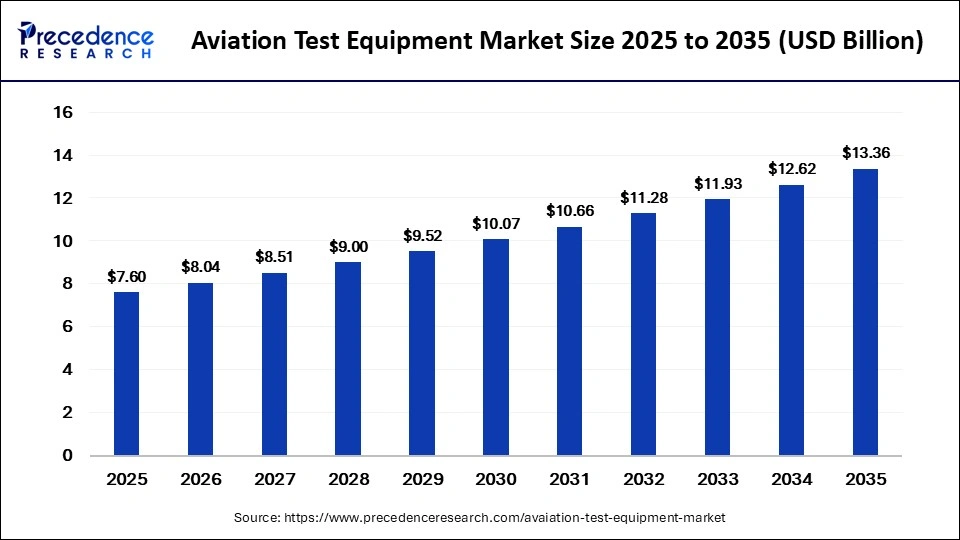
This growth is largely attributed to increasing maintenance, repair, and overhaul (MRO) activities, rising aircraft production, and the integration of sophisticated avionics systems.
Read Also: Green Commodities Market
Quick Insights: What Are the Key Market Highlights?
The aviation test equipment market is expected to grow steadily from USD 7.60 billion in 2025 to USD 13.36 billion by 2035.
North America dominated the market with a 38% share, supported by strong aerospace infrastructure and defense investments.
Asia Pacific is projected to grow at the fastest CAGR of 7.5% due to rising air traffic and expanding aviation infrastructure.
Electrical and electronic test equipment accounted for 30% of the market, making it the leading equipment type.
MRO applications contributed 35% of total revenue, highlighting their importance in aircraft lifecycle management.
What Exactly is Aviation Test Equipment and Why Is It Essential?
Aviation test equipment includes specialized systems used to inspect, test, diagnose, and maintain aircraft components and systems. These tools ensure operational safety, compliance with aviation regulations, and optimal performance of aircraft.
Key applications include testing of avionics, engines, hydraulics, electrical systems, and structural components. These systems are essential for airlines, MRO providers, and defense organizations to maintain reliability and minimize operational risks.
AI Role in the Market: How is Artificial Intelligence Revolutionizing Aircraft Testing?
Artificial intelligence is transforming aviation testing by enabling predictive maintenance and advanced diagnostics. AI-powered systems analyze large volumes of operational data to detect anomalies, predict failures, and optimize maintenance schedules.
Additionally, AI enhances automation in testing processes, reducing human error and improving efficiency. This is particularly valuable in addressing the shortage of skilled technicians and managing complex aircraft systems.
Market Growth Factors: What is Driving Market Expansion?
Why Is Aircraft Fleet Expansion Boosting Demand?
The growing number of commercial and defense aircraft worldwide is increasing the need for regular testing and maintenance, driving demand for advanced equipment.
How Do MRO Activities Support Market Growth?
The rising importance of MRO operations in maintaining aging aircraft and ensuring safety is a major driver for test equipment adoption.
Why Are Advanced Avionics Increasing Complexity?
Modern aircraft systems are becoming more sophisticated, requiring advanced testing tools to ensure proper functionality and integration.
How Do Defense Investments Influence the Market?
Increased defense spending and fleet modernization programs are boosting demand for high-performance testing systems.
Opportunities & Trends: What’s Shaping the Future of Aviation Testing?
Are Portable Testing Systems Gaining Popularity?
Yes, portable and handheld testing equipment is becoming increasingly popular due to its flexibility and efficiency in on-site diagnostics.
Can IoT Enable Smarter Testing Systems?
IoT-enabled test equipment allows real-time monitoring and remote diagnostics, improving maintenance efficiency and reducing downtime.
Is Predictive Maintenance the Future?
AI-driven predictive maintenance is emerging as a key trend, enabling proactive issue detection and cost savings.
How Is Urban Air Mobility Creating New Demand?
The rise of eVTOL aircraft and urban air mobility solutions is driving demand for specialized testing equipment tailored to new technologies.
Segmentation Analysis: Where Are the Key Revenue Streams?
By Equipment Type
- Electrical & Electronic Test Equipment: 30% share
- Avionics Test Equipment: fastest-growing segment
- Engine & Fuel System Testing
- Hydraulic & Pneumatic Testing
By Platform
- Commercial aircraft dominate with 40% share
- Military aircraft hold significant share
- UAVs are growing rapidly
By Application
- MRO leads with 35% share
- Production & assembly testing
- Flight line testing
By Technology
- Automated Test Equipment (ATE) dominates with 40% share
Regional Analysis: Which Regions Are Leading the Market?
Why Does North America Lead?
North America leads due to strong aerospace manufacturing capabilities, major OEM presence, and high defense spending.
How Strong is Europe’s Market?
Europe holds a significant share supported by advanced aviation technologies and regulatory frameworks.
Why is Asia Pacific Growing the Fastest?
Asia Pacific is witnessing rapid growth due to increasing air travel, infrastructure investments, and aircraft procurement.
Competitive Landscape: Who Are the Key Players?
Leading companies in the aviation test equipment market include:
- Honeywell International Inc.
- Lockheed Martin Corporation
- RTX Corporation
- BAE Systems plc
- Northrop Grumman Corporation
- Keysight Technologies, Inc.
- Teradyne, Inc.
- Safran S.A.
- Viavi Solutions Inc.
These companies are focusing on AI-enabled diagnostics, automation, and portable testing technologies to strengthen their market presence.
Challenges: What Could Limit Market Growth?
Despite strong growth potential, the market faces several challenges:
- High costs of advanced testing equipment
- Shortage of skilled workforce
- Complex certification and regulatory processes
- Integration challenges with legacy aircraft systems
These factors may impact adoption, particularly in emerging markets.
Case Study: Predictive Maintenance Reducing Aircraft Downtime
Airlines adopting AI-powered predictive maintenance systems have significantly reduced unscheduled downtime and maintenance costs. By identifying potential failures early, these systems improve operational efficiency and enhance passenger safety.
Conclusion: What Lies Ahead for the Market?
The aviation test equipment market is poised for steady growth as the aviation industry continues to evolve. With increasing adoption of AI, IoT, and automation, testing systems are becoming more efficient, reliable, and intelligent.
Companies that invest in advanced technologies and innovative solutions will be well-positioned to capitalize on the growing demand for aviation testing equipment.
Get Sample Link: https://www.precedenceresearch.com/sample/8365
For inquiries regarding discounts, bulk purchases, or customization requests, please contact us at sales@precedenceresearch.com
