
Dark Store Market Size to Worth USD 721.98 Billion by 2035
The global dark store market size reached USD 31.61 billion in 2025 and is anticipated to expand significantly, reaching nearly USD 721.98 billion by 2035 at a CAGR of 36.73% between 2026 and 2035. The market is witnessing strong growth due to the increasing adoption of online grocery services, the proliferation of e-commerce platforms, and retailers’ focus on enhancing last-mile delivery efficiency while reducing operational costs.
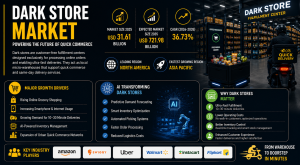
What is a Dark Store?
A dark store is a retail facility or micro-fulfillment center designed exclusively for online order processing and delivery. While it resembles a traditional supermarket in layout and inventory organization, customers cannot enter or shop in these locations.
Dark stores are strategically located near densely populated urban areas, allowing businesses to fulfill online orders quickly and reduce delivery times. They serve as a bridge between warehouses and consumers, helping companies achieve faster and more efficient order fulfillment.
Dark Store Market Overview
The dark store market has become one of the fastest-growing segments within the retail and e-commerce industry. The expansion of online grocery shopping, increasing adoption of quick-commerce platforms, and growing demand for same-day delivery services have accelerated market growth globally.
Retailers are increasingly shifting from conventional fulfillment methods to localized dark store networks. This transition helps businesses reduce delivery costs, improve inventory visibility, and offer faster service to customers.
Additionally, advances in automation, artificial intelligence, and data analytics are enabling dark stores to operate more efficiently, making them a preferred fulfillment model for modern retailers.
Dark Store Market Growth
The growth of the dark store market is strongly linked to the rise of e-commerce and digital grocery shopping. Consumers are increasingly relying on mobile applications and online platforms to purchase groceries, personal care products, and household essentials. This shift in shopping behavior has created a need for fulfillment centers capable of handling high order volumes while ensuring rapid delivery.
The emergence of quick-commerce services has further accelerated demand for dark stores. Companies offering deliveries within 10 to 30 minutes depend heavily on strategically located micro-fulfillment centers to maintain speed and operational efficiency. As a result, retailers and logistics providers continue expanding their dark store footprints across major urban markets.
Key Dark Store Market Trends
- Rise of Quick Commerce: Quick-commerce platforms are reshaping consumer expectations by offering ultra-fast delivery services. Dark stores serve as the operational backbone of these platforms, enabling companies to deliver products within minutes rather than days.
- Expansion of Micro-Fulfillment Centers: Retailers are increasingly adopting smaller fulfillment hubs located close to consumers. These micro-fulfillment centers help reduce delivery times and improve inventory efficiency.
- Growing Adoption of Automation: Automation technologies such as robotic picking systems, AI-powered inventory management, and automated sorting solutions are transforming dark store operations by improving accuracy and reducing labor costs.
- Data-Driven Inventory Optimization: Advanced analytics and machine learning tools are helping retailers predict demand, optimize stock levels, and minimize inventory waste, leading to greater operational efficiency.
Dark Store Market Dynamics
Driver
Growing Demand for Fast Deliveries
Consumers increasingly expect same-day and instant delivery services. Dark stores help retailers meet these expectations by positioning inventory closer to customers and enabling faster order fulfillment. The rapid expansion of online grocery shopping and quick-commerce services continues to fuel market demand.
Opportunity
Technological Advancements
Emerging technologies such as artificial intelligence, robotics, warehouse automation, and predictive analytics are creating significant opportunities for dark store operators. These innovations improve operational efficiency, reduce costs, and enhance customer satisfaction.
Challenge
High Operational Costs
Despite their benefits, dark stores require substantial investments in real estate, inventory management systems, automation technologies, and delivery infrastructure. Rising urban property costs and intense competition can impact profitability.
How Technology is Transforming Dark Stores
Technology plays a central role in the success of dark store operations. Modern facilities utilize AI-powered demand forecasting systems to predict purchasing trends and maintain optimal inventory levels. Automated picking systems and robotics help accelerate order processing while reducing human error.
Cloud-based inventory management platforms provide real-time visibility into stock availability, enabling faster replenishment and reducing stockouts. Route optimization software improves delivery efficiency by identifying the fastest and most cost-effective delivery paths.
Regional Analysis
North America currently represents one of the largest markets for dark stores due to its advanced e-commerce ecosystem, high internet penetration, and strong consumer demand for rapid delivery services.
European countries have witnessed significant adoption of dark store models, particularly in urban areas where online grocery shopping and same-day delivery services are becoming increasingly popular.
Asia-Pacific is expected to experience the fastest growth during the forecast period. Rapid urbanization, increasing smartphone usage, expanding digital payment adoption, and the rise of quick-commerce companies are driving market expansion across the region. Countries such as India, China, and Southeast Asian nations are becoming major growth centers for dark store investments.
Competitive Landscape
The dark store market is highly competitive, with retailers, grocery chains, e-commerce platforms, and quick-commerce companies investing heavily in fulfillment infrastructure. Market participants focus on expanding their store networks, adopting automation technologies, and improving delivery efficiency to gain a competitive advantage.
Key companies operating in the market include Amazon, Walmart, Instacart, Flipkart, Swiggy Instamart, Zepto, Target, Grab, and other regional quick-commerce providers.
Future Outlook of the Dark Store Market
The future of the dark store market appears highly promising as retailers continue adapting to changing consumer preferences. The growing popularity of online grocery shopping, demand for ultra-fast delivery services, and advancements in fulfillment technologies are expected to sustain strong market growth over the next decade.
Artificial intelligence, robotics, and automation will play an increasingly important role in improving efficiency and reducing operating costs. Additionally, the expansion of quick-commerce ecosystems and increasing urbanization will create new opportunities for dark store development worldwide.
Get Sample Link: https://www.precedenceresearch.com/sample/2461
Also Read: Materials for Bone Implants Market

- Dark Store Market Size to Worth USD 721.98 Billion by 2035 - June 16, 2026
- In Vitro Diagnostics Market Size to Attain USD 252.42 Billion by 2035 - June 15, 2026
- Synthetic Biology Market Size to Surpass USD 252.42 Billion by 2035 - June 15, 2026