
ESG Software Market Size to Hit USD 31.96 Billion by 2035
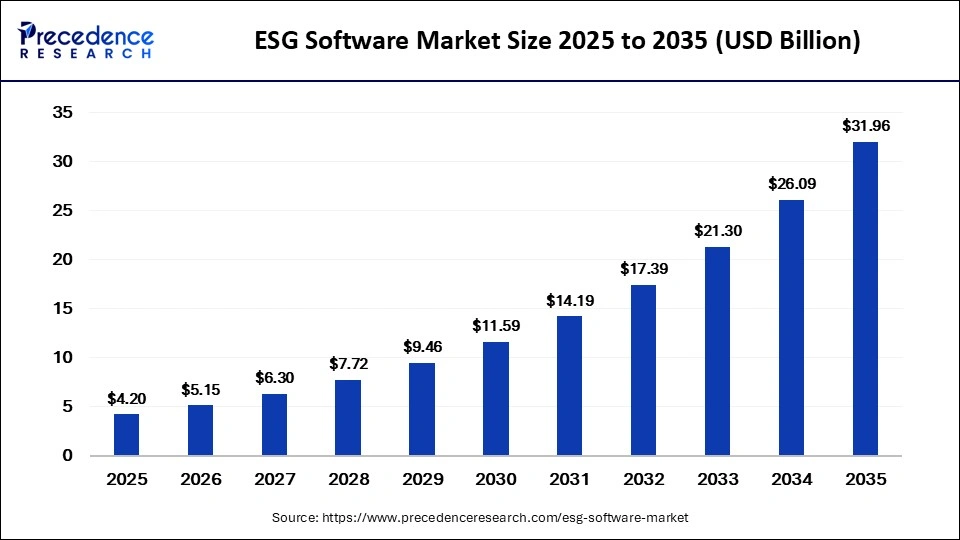
The global ESG software market is projected to grow from USD 5.15 billion in 2026 to USD 31.96 billion by 2035 at a CAGR of 22.50%, driven by AI-powered analytics, mandatory ESG disclosures, cloud adoption, and sustainability reporting demands.
The global ESG software market is witnessing extraordinary growth as organizations increasingly prioritize sustainability, governance transparency, and regulatory compliance. The market size was valued at USD 4.20 billion in 2025 and is projected to increase from USD 5.15 billion in 2026 to approximately USD 31.96 billion by 2035, registering a remarkable CAGR of 22.50% during the forecast period. The market is rapidly expanding due to mandatory reporting regulations, increasing demand for audit-ready ESG data, and the transition from spreadsheet-based reporting toward automated digital ESG platforms.
Modern enterprises are increasingly deploying ESG software to streamline carbon accounting, sustainability reporting, governance management, and compliance monitoring. The growing pressure from investors, regulators, and consumers for transparent ESG disclosures is accelerating adoption across industries worldwide.
Read Also: Project and Portfolio Management Software Market
What is ESG Software and Why is it Becoming Essential?
Environmental, Social, and Governance (ESG) software helps organizations collect, manage, analyze, and report sustainability-related data across operations and supply chains. These platforms enable enterprises to:
- Automate sustainability disclosures
- Track carbon emissions and ESG KPIs
- Improve audit readiness
- Monitor governance and compliance risks
- Enhance supplier transparency
- Generate investor-grade ESG reports
Organizations are increasingly moving away from fragmented manual reporting systems toward unified, cloud-native ESG management platforms capable of supporting frameworks such as CSRD, ISSB, SASB, GRI, and TCFD.
AI Integration Reshaping the ESG Software Industry
Artificial intelligence is becoming a transformative force in the ESG software market. AI-powered ESG platforms are enabling businesses to automate data extraction, predictive analytics, anomaly detection, and regulatory reporting with significantly improved efficiency and accuracy.
According to market insights, AI integration can reduce ESG reporting costs by more than 90% while improving audit reliability and operational scalability.
AI-enabled ESG solutions now support:
- Predictive climate risk analysis
- Automated carbon accounting
- Real-time sustainability monitoring
- Materiality assessments
- Intelligent compliance reporting
- Supply chain traceability
Recent developments also highlight rising investments in AI-driven ESG innovation. In 2026, Dcycle acquired ESG-X to strengthen AI-powered sustainability reporting capabilities across Europe.
Key Market Highlights
- North America held the largest ESG software market share of 38% in 2025.
- Asia-Pacific is expected to grow at the fastest CAGR of 25% during 2026-2035.
- The software segment accounted for 70% of the market share in 2025.
- Cloud-based deployment dominated with a 75% revenue share.
- Sustainability management held the largest functionality share of 35%.
- Manufacturing emerged as the leading end-use industry with a 20% market share.
- Large enterprises accounted for 70% of the market share in 2025.
- SMEs are projected to witness the fastest growth due to rising cloud adoption and compliance requirements.
Key Trends Driving the ESG Software Market
Mandatory ESG Reporting Regulations Accelerating Adoption
Governments and regulatory authorities worldwide are introducing stricter sustainability disclosure mandates. Regulations such as the EU’s Corporate Sustainability Reporting Directive (CSRD), SEC climate disclosure frameworks, and SEBI’s BRSR regulations in India are compelling enterprises to adopt advanced ESG reporting platforms.
Businesses are increasingly investing in ESG software to simplify compliance management, automate disclosures, and improve investor transparency.
Cloud-Based ESG Platforms Gaining Massive Traction
Cloud deployment continues to dominate the ESG software market due to scalability, lower infrastructure costs, and simplified implementation.
Cloud-native ESG platforms enable organizations to centralize sustainability data, automate workflows, and improve cross-functional collaboration across global operations. The cloud-based deployment segment accounted for 75% of the market share in 2025.
Growing Demand for Carbon Accounting Solutions
As global net-zero commitments accelerate, organizations are increasingly investing in carbon accounting and emissions management tools.
Modern ESG software platforms now offer advanced Scope 1, Scope 2, and Scope 3 emissions tracking capabilities to help businesses measure environmental impact more accurately and comply with global climate regulations.
ESG Integration Across Enterprise Operations
ESG software is increasingly being integrated with ERP, GRC, EHS, and supply chain management systems to create unified sustainability ecosystems. This integration enables enterprises to improve operational visibility, automate compliance processes, and strengthen governance frameworks.
Market Dynamics
Driver: Growing Demand for Transparency and Audit-Ready ESG Data
The growing emphasis on sustainability transparency and investor accountability is a major driver of the ESG software market.
Investors, regulators, and stakeholders increasingly require standardized, auditable ESG data for risk analysis and long-term value assessment. Enterprises are rapidly adopting ESG platforms to improve disclosure accuracy and reduce reliance on manual reporting systems.
Restraint: Fragmented ESG Frameworks and Data Complexity
Despite strong growth potential, the market faces challenges related to fragmented ESG standards, inconsistent regulations across regions, and complex data integration processes.
Organizations often struggle with scattered sustainability data spread across departments and supply chains. Lack of ESG expertise and interoperability issues continue to create operational barriers for many enterprises.
Industry discussions also indicate that many ESG reporting tools remain expensive and overly complex for mid-sized businesses.
Opportunity: Predictive Analytics and AI-Driven ESG Intelligence
The increasing adoption of AI and advanced analytics is creating significant opportunities within the ESG software market.
AI-powered ESG platforms can automate risk forecasting, materiality analysis, climate scenario planning, and compliance monitoring. Organizations leveraging predictive ESG intelligence are expected to gain stronger operational resilience and competitive advantages over the coming decade.
Segmental Insights
Software Segment Dominated the Market
The software segment accounted for the largest market share of 70% in 2025 due to growing enterprise demand for automated ESG tracking, carbon accounting, and sustainability analytics solutions. Organizations are increasingly integrating AI-powered analytics into ESG reporting workflows to improve efficiency and data accuracy.
Cloud-Based Deployment Led the Industry
Cloud-based ESG software solutions dominated the market with a 75% share in 2025 because of their scalability, flexibility, and reduced deployment costs. SMEs are increasingly adopting cloud-native ESG platforms to improve sustainability reporting without major infrastructure investments.
Sustainability Management Emerged as the Leading Functionality
The sustainability management segment captured 35% of the market share in 2025 as organizations intensified efforts to reduce carbon emissions, improve energy efficiency, and achieve ESG targets.
Environmental management and governance tracking functionalities are also experiencing rapid adoption across manufacturing, energy, healthcare, and financial services sectors.
Manufacturing Sector Held the Largest End-Use Share
Manufacturing accounted for the largest market share of 20% in 2025 due to increasing pressure to improve supply chain sustainability, reduce emissions, and comply with environmental regulations.
Industries including BFSI, IT & telecom, healthcare, retail, and energy are also rapidly deploying ESG software solutions to improve transparency and operational resilience.
Regional Insights
North America Maintains Market Leadership
North America dominated the ESG software market in 2025 due to stringent disclosure regulations, advanced digital infrastructure, and strong investor demand for sustainability transparency.
The United States continues to lead regional growth as enterprises increasingly adopt AI-powered ESG reporting systems and climate risk management platforms.
Asia-Pacific Emerging as the Fastest-Growing Region
Asia-Pacific is expected to witness the fastest CAGR of 25% during the forecast period due to rapid digital transformation, increasing sustainability initiatives, and government-backed ESG compliance programs.
Countries such as China, Japan, and India are heavily investing in green finance, carbon neutrality programs, and ESG reporting infrastructure.
India, in particular, is becoming a major ESG software growth hub due to SEBI’s BRSR reporting requirements and growing participation in global supply chains.
Europe Accelerating ESG Technology Investments
Europe remains a major center for ESG software innovation due to strict sustainability regulations and rising investments in AI-powered ESG platforms.
The region is witnessing rapid adoption of advanced ESG reporting tools across manufacturing, finance, and energy industries. Strategic acquisitions and AI-focused ESG partnerships are further strengthening Europe’s market landscape.
Competitive Landscape
Key companies operating in the ESG software market include:
- SAP
- Oracle
- IBM
- Nasdaq
- Workiva
- Diligent
- Benchmark Gensuite
- Intelex Technologies
- Sphera
- Novisto
These companies are actively focusing on AI integration, predictive ESG analytics, automated reporting systems, and cloud-based deployment models to strengthen their competitive position.
Future Outlook
The ESG software market is expected to witness extraordinary growth over the next decade as sustainability reporting evolves into a strategic business necessity rather than a regulatory obligation.
The convergence of AI, cloud computing, predictive analytics, and carbon accounting technologies will continue transforming ESG management into a core enterprise intelligence function.
As organizations increasingly prioritize sustainability, transparency, and operational resilience, global demand for intelligent ESG software platforms is projected to surge significantly.
Get a Sample Copy: https://www.precedenceresearch.com/sample/8420
For inquiries regarding discounts, bulk purchases, or customization requests, please contact us at sales@precedenceresearch.com
