
Human Centric Lighting Market Size to Hit USD 75.00 Billion by 2035
The global human centric lighting market is projected to reach USD 7.23 billion in 2026 and grow to USD 75.00 billion by 2035, driven by smart lighting demand, AI integration, and sustainable infrastructure development.
Human Centric Lighting Market Size in 2026
The global human centric lighting market size was valued at USD 5.58 billion in 2025 and is expected to reach USD 7.23 billion in 2026. Looking ahead, the market is projected to surge to approximately USD 75.00 billion by 2035, expanding at a CAGR of 29.68% from 2026 to 2035.
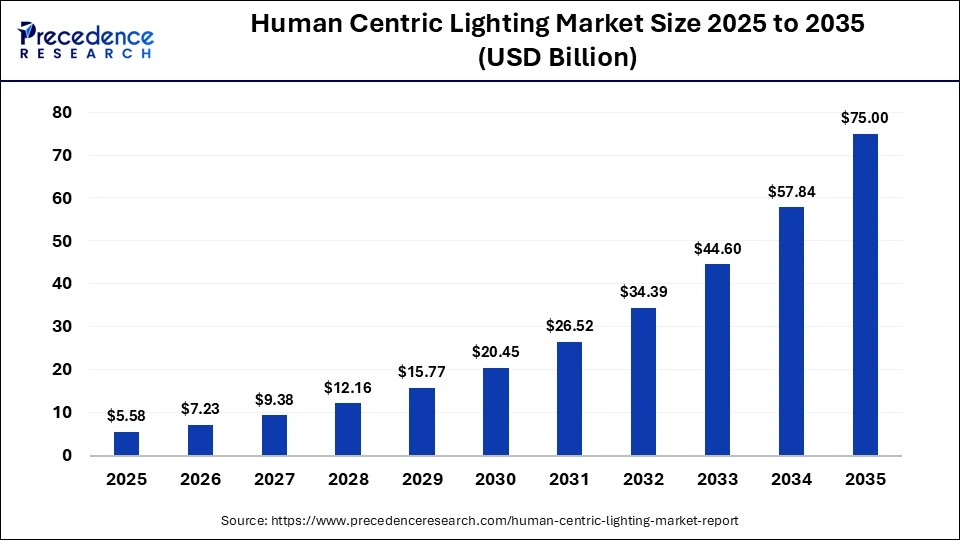
This rapid expansion reflects the increasing demand for intelligent lighting systems designed to improve human health, productivity, and well-being across residential, commercial, and industrial environments.
Read Also: Tau Protein Targeting Therapeutics Market
Market Overview
Human Centric Lighting (HCL) goes beyond traditional illumination by aligning artificial lighting with the human circadian rhythm. These systems dynamically adjust brightness and color temperature throughout the day to mimic natural sunlight patterns.
HCL is widely used in:
- Offices and corporate buildings
- Healthcare facilities and hospitals
- Educational institutions
- Residential smart homes
- Industrial workplaces
The core objective is to enhance alertness during daytime and promote relaxation during evening hours, improving overall human performance and wellness.
Key Market Highlights (2026–2035)
- Europe held the largest share of 39% in 2025
- Asia-Pacific is projected to grow at the fastest CAGR
- Fixtures segment dominated the market with 36% share
- Services segment is the fastest-growing category
- New installation accounted for 68% share
- Commercial applications held 60% market share
- Residential segment is expanding rapidly due to smart home adoption
Market Drivers
1. Rising Focus on Employee Well-being
Organizations are increasingly adopting HCL systems to reduce fatigue, improve concentration, and boost productivity in workplaces.
2. Expansion of Smart Infrastructure
Rapid urbanization and smart city development are fueling demand for intelligent lighting solutions integrated with IoT systems.
3. Energy Efficiency Demand
HCL systems help reduce energy consumption through automated lighting adjustments based on daylight availability.
4. Healthcare and Education Adoption
Hospitals and schools are using circadian lighting to improve patient recovery rates and student performance.
AI Impact on Human Centric Lighting Market
Artificial Intelligence is transforming the HCL industry by enabling:
- Real-time lighting adjustments based on human presence
- Automated circadian rhythm optimization
- Energy usage optimization
- Smart building integration
- Predictive maintenance of lighting systems
AI-powered lighting systems are becoming essential in modern smart buildings, significantly improving operational efficiency and user experience.
Market Trends
- Increasing adoption of smart LED lighting systems
- Growth in retrofit lighting projects
- Rising demand for biophilic and wellness-based design
- Integration of IoT-enabled smart lighting controls
- Expansion of sustainable and energy-efficient infrastructure
Market Segmentation
By Product
- Fixtures (dominant segment)
- Controllers
- Sensors
- Drivers
- Software
- Services
By Installation Type
- New Installation (leading segment)
- Retrofit (fastest growing)
By Application
- Commercial (dominant)
- Residential (fastest growing)
- Healthcare
- Education
- Industrial
Regional Analysis
Europe – Market Leader
Europe dominated the market due to strict energy efficiency regulations and strong adoption of smart building technologies. Countries like Germany and the UK are major contributors.
Asia-Pacific – Fastest Growing Region
Asia-Pacific is expected to expand at the highest CAGR due to:
- Rapid urbanization
- Growing smart city projects
- Rising disposable income
- Increasing awareness of workplace wellness
North America
North America remains a strong market driven by advanced infrastructure and high adoption of smart lighting systems in commercial buildings.
Market Challenges
- High initial installation costs
- Complex integration with existing infrastructure
- Limited awareness in developing regions
- Technical maintenance requirements
Opportunities
- Growth of smart home ecosystems
- Expansion of LED-based lighting technologies
- Increasing adoption in healthcare infrastructure
- Government support for energy-efficient buildings
- Rising demand for human wellness-focused design
Competitive Landscape
Key players in the human centric lighting market include:
- Signify Holding
- Osram Licht AG
- Acuity Brands Inc.
- Schneider Electric
- Eaton Corporation
- Lutron Electronics
- Zumtobel Group
- Trilux Group
- Wipro Lighting
- Legrand SA
These companies are focusing on smart lighting innovation, IoT integration, and AI-based automation.
Conclusion
The human centric lighting market is undergoing rapid transformation as industries increasingly prioritize human wellness, energy efficiency, and smart infrastructure. With strong technological integration and expanding applications across sectors, the market is expected to witness exponential growth through 2035.
Get a Sample Copy: https://www.precedenceresearch.com/sample/8227
For inquiries regarding discounts, bulk purchases, or customization requests, please contact us at sales@precedenceresearch.com
