
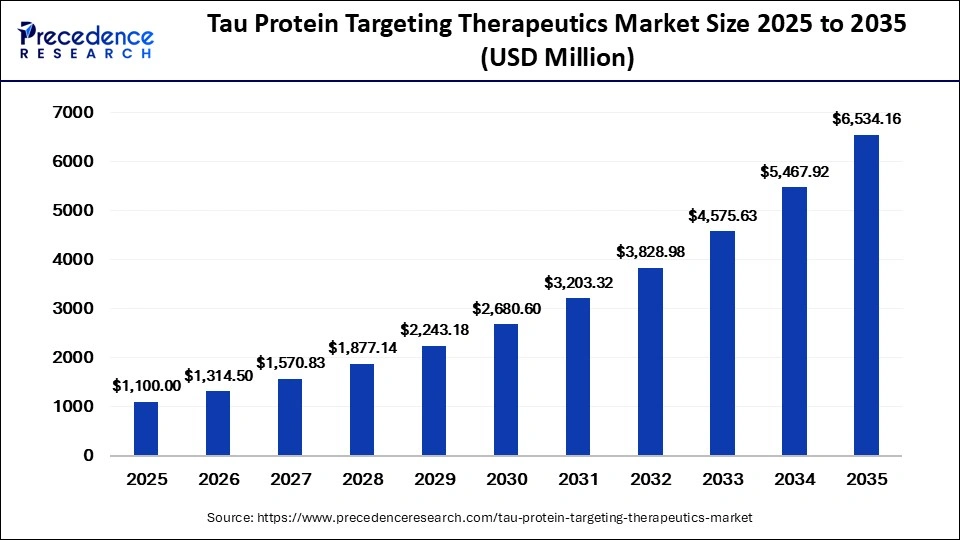
Tau Protein Targeting Therapeutics Market Size to Reach USD 6,534.16 Million by 2035
The global tau protein targeting therapeutics market is expanding rapidly due to rising Alzheimer’s disease prevalence, advancements in neurodegenerative disease therapies, AI-driven drug discovery, and increasing investment in tau-targeted clinical research.
Tau Protein Targeting Therapeutics Market Overview
The global tau protein targeting therapeutics market is emerging as one of the most promising segments within the neurodegenerative disease treatment landscape. Growing prevalence of Alzheimer’s disease, frontotemporal dementia, progressive supranuclear palsy (PSP), and other tauopathies is significantly accelerating research and investment in tau-targeted therapies worldwide.
Tau protein has become a major therapeutic focus because abnormal tau accumulation and neurofibrillary tangles are strongly associated with cognitive decline and neurodegeneration. While earlier Alzheimer’s therapies largely focused on amyloid-beta plaques, recent scientific advancements are increasingly shifting attention toward tau pathology as a potentially more effective disease-modifying target.
The market is witnessing strong momentum due to advances in monoclonal antibodies, antisense oligonucleotides (ASOs), gene therapies, immunotherapies, and AI-powered drug discovery platforms.
Read Also: Cleaning Services Market
What are Tau Protein Targeting Therapeutics?
Tau protein targeting therapeutics are specialized treatments designed to prevent, reduce, or eliminate abnormal tau protein accumulation in the brain.
These therapies aim to:
- Prevent tau aggregation
- Reduce tau phosphorylation
- Block neurofibrillary tangle formation
- Enhance tau clearance
- Protect neuronal function
- Slow neurodegeneration progression
Tau-targeted therapies are increasingly being developed for conditions such as:
- Alzheimer’s disease
- Frontotemporal dementia (FTD)
- Progressive supranuclear palsy (PSP)
- Corticobasal degeneration (CBD)
- Parkinson’s-related dementia
- Other tauopathies
Research suggests tau pathology correlates more closely with cognitive decline severity than amyloid-beta accumulation, making it a highly attractive therapeutic target.
Key Market Highlights
- Rising prevalence of Alzheimer’s disease is driving market expansion globally.
- Monoclonal antibodies remain a dominant therapeutic development area.
- Antisense oligonucleotide (ASO) therapies are gaining strong clinical momentum.
- North America leads the market due to advanced neuroscience research infrastructure.
- Asia-Pacific is expected to witness rapid growth due to increasing aging populations.
- AI-powered drug discovery is accelerating therapeutic pipeline development.
- Growing investments in neurodegenerative disease clinical trials continue supporting market growth.
How AI is Accelerating the Tau Protein Targeting Therapeutics Market
Artificial intelligence is playing a transformative role in neurodegenerative disease drug discovery by improving target identification, biomarker analysis, and clinical trial optimization.
AI-powered technologies help researchers:
- Analyze complex neurological datasets
- Predict protein folding abnormalities
- Accelerate drug screening
- Optimize molecular design
- Improve patient stratification
- Enhance clinical trial success probabilities
Machine learning algorithms are increasingly used to identify tau aggregation patterns and predict therapeutic responses, significantly reducing research timelines and development costs.
AI integration is also supporting personalized medicine approaches for Alzheimer’s and related tauopathies.
Major Trends Driving the Tau Protein Targeting Therapeutics Market
Growing Focus on Disease-Modifying Alzheimer’s Therapies
The limited long-term success of amyloid-beta-targeting treatments has accelerated industry focus toward tau-based therapies.
Research increasingly suggests that tau pathology plays a direct role in:
- Neuronal dysfunction
- Synaptic degeneration
- Cognitive decline
- Disease progression
This has resulted in significant expansion of anti-tau therapeutic pipelines globally.
Expansion of Monoclonal Antibody Therapies
Monoclonal antibodies targeting pathological tau proteins remain among the most actively developed therapeutic categories.
Several antibody-based therapies are currently in Phase I, II, and III clinical trials.
These therapies aim to:
- Neutralize toxic tau species
- Prevent tau spread between neurons
- Promote immune-mediated clearance
The growing maturity of immunotherapy platforms is significantly boosting market potential.
Rising Adoption of Gene Silencing Technologies
Antisense oligonucleotides (ASOs) and siRNA-based therapies are emerging as highly promising treatment approaches.
These therapies target the MAPT gene responsible for tau protein production, helping reduce abnormal tau accumulation.
Several companies are advancing clinical-stage ASO programs for Alzheimer’s disease and PSP.
Increasing Investment in Neurodegenerative Research
Governments, pharmaceutical companies, and biotechnology firms are significantly increasing investments in neurodegenerative disease research.
Growing healthcare burden associated with aging populations is accelerating funding for:
- Precision medicine
- Biomarker research
- Neuroimaging technologies
- Regenerative medicine
- AI-assisted clinical trials
This investment environment is expected to support long-term market growth.
Market Dynamics
Driver: Rising Prevalence of Alzheimer’s Disease and Tauopathies
The increasing global incidence of neurodegenerative diseases is a major driver of the tau protein targeting therapeutics market.
Alzheimer’s disease remains one of the fastest-growing neurological disorders globally, creating urgent demand for disease-modifying treatments.
Research increasingly demonstrates that tau pathology correlates strongly with disease severity and progression.
Growing aging populations worldwide continue accelerating demand for advanced neurological therapies.
Restraint: High Clinical Trial Failure Rates
Despite major scientific progress, neurodegenerative disease drug development remains highly challenging.
Common barriers include:
- Complex disease biology
- Long clinical timelines
- High development costs
- Difficulty measuring efficacy
- Blood-brain barrier challenges
- Regulatory uncertainties
Several tau-targeting therapies have previously failed to demonstrate sufficient clinical benefit despite promising preclinical results.
Opportunity: Personalized Neurology and Precision Medicine
Precision medicine approaches represent a major opportunity for future market expansion.
Emerging technologies now enable:
- Patient-specific treatment strategies
- Biomarker-driven diagnosis
- Genetic profiling
- Early-stage disease detection
- Personalized therapeutic interventions
The integration of AI, genomics, and neuroimaging is expected to improve treatment success rates and accelerate commercial adoption.
Segmental Insights
Monoclonal Antibodies Leading Clinical Development
Monoclonal antibodies represent one of the most advanced therapeutic categories in the market.
These therapies target extracellular tau proteins and aim to interrupt pathological spreading between neurons.
Several major pharmaceutical companies are actively advancing anti-tau monoclonal antibody candidates through late-stage clinical trials.
Antisense Oligonucleotide (ASO) Therapies Gaining Momentum
ASO therapies are rapidly becoming a critical focus area due to their ability to directly suppress tau protein expression.
Companies including Biogen and Novartis are actively developing intrathecal ASO therapies targeting MAPT expression.
These therapies are showing promising biomarker reductions and target engagement in clinical studies.
Alzheimer’s Disease Remains Primary Application Area
Alzheimer’s disease represents the largest therapeutic application segment due to the enormous global patient population and unmet medical need.
The growing burden of dementia worldwide continues driving clinical research and commercialization efforts.
Regional Insights
North America Dominates the Market
North America leads the tau protein targeting therapeutics market due to:
- Strong neuroscience research infrastructure
- Advanced biotechnology ecosystem
- High healthcare expenditure
- Strong regulatory support
- Presence of leading pharmaceutical companies
The United States remains the global center for Alzheimer’s clinical trials and neurodegenerative drug innovation.
Europe Expanding Neurological Research Investment
Europe continues witnessing strong growth due to increasing investments in neuroscience research, aging population concerns, and expansion of precision medicine programs.
Countries such as Germany, the UK, and Switzerland are actively supporting neurodegenerative disease innovation.
Asia-Pacific Emerging as High-Growth Region
Asia-Pacific is expected to witness rapid market expansion due to:
- Growing elderly population
- Increasing dementia prevalence
- Expanding healthcare infrastructure
- Rising biotechnology investments
- Government support for neuroscience research
China and Japan are becoming major contributors to neurodegenerative disease research initiatives.
Competitive Landscape
Major companies operating in the tau protein targeting therapeutics market include:
- Biogen
- Novartis
- Bristol Myers Squibb
- Eisai
- Genentech
- Ionis Pharmaceuticals
- TauRx Therapeutics
- GlaxoSmithKline
- UCB Biopharma
- Annovis Bio
- Alector
- Lundbeck
These companies are focusing heavily on:
- Monoclonal antibodies
- ASO therapies
- AI-driven drug discovery
- Biomarker development
- Precision neurology
- Immunotherapy platforms
to strengthen their competitive positions.
Recent Industry Developments
Biogen Advanced Tau Therapy Development
In 2026, Biogen reported mixed but promising results from trials involving its tau-targeting Alzheimer’s therapy diranersen developed with Ionis Pharmaceuticals. The company plans to advance the therapy into later-stage studies despite mixed dose-response findings.
Expansion of Clinical-Stage Tau Therapeutic Pipeline
Recent industry reviews indicate that more than 170 tau-targeting therapeutic programs are currently under development across discovery, preclinical, and clinical stages.
The pipeline includes:
- Small molecules
- Monoclonal antibodies
- Vaccines
- ASOs
- siRNA therapies
- Aggregation inhibitors
Future Outlook
The future of the tau protein targeting therapeutics market remains highly promising as the global healthcare industry intensifies efforts to combat Alzheimer’s disease and related neurodegenerative disorders.
Future market growth will be driven by:
- AI-powered drug discovery
- Precision neurology
- Biomarker-based diagnostics
- Gene silencing technologies
- Advanced immunotherapies
- Early disease detection
As scientific understanding of tau pathology continues advancing, tau-targeted therapeutics are expected to become a cornerstone of next-generation neurodegenerative disease treatment strategies.
Get a Sample Copy: https://www.precedenceresearch.com/sample/8423
For inquiries regarding discounts, bulk purchases, or customization requests, please contact us at sales@precedenceresearch.com
