
AI Explainability and Transparency Market to Reach USD 26.51 Billion by 2035
The global AI explainability and transparency market is projected to reach USD 26.51 billion by 2035, fueled by rising regulatory scrutiny, ethical AI adoption, generative AI governance, and enterprise demand for trustworthy AI systems.
AI Explainability and Transparency Market Overview
The global AI explainability and transparency market is witnessing significant growth as enterprises increasingly prioritize trustworthy, ethical, and accountable artificial intelligence systems. According to Precedence Research, the market size was valued at USD 3.40 billion in 2025 and is projected to grow from USD 4.18 billion in 2026 to approximately USD 26.51 billion by 2035, expanding at a CAGR of 22.80% during the forecast period.
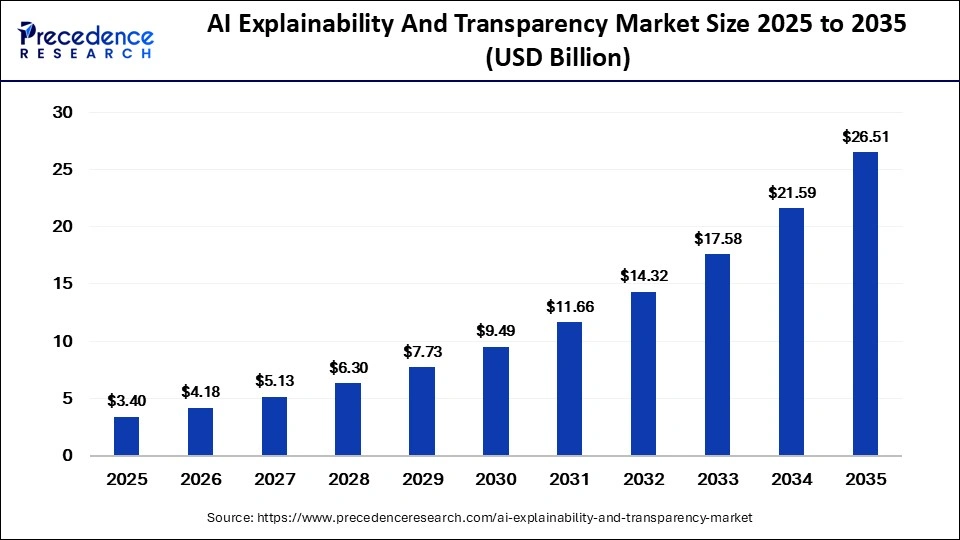
The rapid expansion of generative AI, large language models (LLMs), predictive analytics, and autonomous AI systems has intensified concerns surrounding black-box decision-making environments. Organizations now require AI systems capable of providing clear explanations regarding how predictions, recommendations, and automated decisions are generated.
AI explainability and transparency technologies are becoming increasingly critical across industries such as BFSI, healthcare, government, retail, manufacturing, cybersecurity, and telecommunications. Businesses are investing heavily in explainable AI (XAI), governance frameworks, bias detection systems, model monitoring tools, and compliance management solutions to strengthen trust in AI-driven operations.
The growing regulatory focus on ethical AI governance, fairness, accountability, and transparency is further accelerating market growth globally.
Read Also: Low Code AI Platform Market
Understanding AI Explainability and Transparency
AI explainability refers to the ability of artificial intelligence systems to provide understandable explanations regarding how outputs, predictions, or recommendations are generated. Transparency focuses on making AI systems more visible, traceable, and accountable to users, regulators, and organizations.
These technologies help organizations:
- Understand AI-driven decisions
- Improve trust in automation systems
- Detect and reduce algorithmic bias
- Strengthen compliance management
- Monitor AI behavior continuously
- Improve governance and accountability
- Validate AI-generated recommendations
Explainability and transparency are particularly important in regulated sectors where AI decisions directly affect individuals, such as healthcare diagnostics, loan approvals, fraud detection, insurance underwriting, and recruitment systems.
Key Market Drivers
Rising Demand for Ethical and Responsible AI
One of the strongest drivers of the AI explainability and transparency market is the growing global emphasis on ethical and responsible AI deployment.
Organizations increasingly face pressure from regulators, customers, and stakeholders to ensure AI systems operate fairly, transparently, and without discriminatory bias.
Businesses deploying AI technologies now require systems capable of explaining how algorithms generate predictions and decisions, especially in high-risk applications such as:
- Credit scoring
- Fraud detection
- Hiring and recruitment
- Healthcare diagnostics
- Insurance risk assessment
- Cybersecurity monitoring
Explainable AI technologies help enterprises improve customer trust while minimizing legal, operational, and reputational risks.
The rapid adoption of autonomous AI agents and generative AI copilots is further increasing demand for explainability infrastructure.
Increasing Global Regulatory Pressure
Governments and regulatory authorities worldwide are implementing stricter AI governance regulations.
Frameworks such as the European Union AI Act and GDPR are accelerating enterprise investments in explainability and transparency solutions. Organizations increasingly require AI systems capable of supporting:
- Audit trails
- Decision traceability
- Bias monitoring
- Risk assessments
- Compliance reporting
- Model documentation
Regulatory scrutiny surrounding fairness, accountability, and privacy is expected to remain a major long-term market driver.
Rapid Expansion of Generative AI
The explosive rise of generative AI technologies is significantly boosting demand for explainability solutions.
Large language models, AI assistants, and autonomous AI systems are increasingly integrated into enterprise workflows, creating concerns related to hallucinations, misinformation, and automated decision accountability.
Organizations increasingly deploy explainability layers such as:
- Confidence scoring
- Source attribution
- Model interpretability dashboards
- AI monitoring systems
- Human oversight frameworks
These technologies help improve governance while strengthening trust in AI-generated outputs.
Growing Adoption Across BFSI and Healthcare
The BFSI sector accounted for approximately 30% of the market share in 2025, making it the leading end-use industry.
Financial institutions increasingly deploy explainability technologies to improve transparency in:
- Fraud detection
- Credit approvals
- Risk management
- Customer verification
- Compliance management
Healthcare organizations are also rapidly adopting explainable AI systems for diagnostics, clinical decision support, patient monitoring, and treatment recommendations.
Transparent AI systems are becoming essential for improving clinician trust and patient safety.
Market Restraints
Complexity of Interpreting Advanced AI Models
One of the biggest challenges in the market is the technical difficulty of interpreting highly sophisticated neural networks and deep learning systems.
Advanced AI models often function as “black boxes,” making it difficult to fully understand how outputs are generated. Balancing explainability with model performance remains a major challenge for developers and enterprises.
Lack of Standardized Explainability Frameworks
The absence of universal explainability standards creates operational and regulatory uncertainty.
Different industries, organizations, and regulatory bodies often define explainability and transparency differently, leading to inconsistent governance practices.
This lack of standardization may slow large-scale adoption in highly regulated sectors.
Integration Challenges with Enterprise Infrastructure
Many organizations face difficulties integrating explainability solutions into existing enterprise AI ecosystems and legacy IT infrastructures.
Complex environments frequently require customized governance frameworks capable of supporting multiple AI models, workflows, and compliance systems simultaneously.
Emerging Opportunities
Rise of Responsible AI Governance Platforms
The emergence of enterprise-wide responsible AI governance ecosystems is creating major opportunities for explainability technology providers.
Organizations increasingly establish dedicated responsible AI teams focused on:
- Fairness monitoring
- Governance automation
- Compliance oversight
- AI risk management
- Transparency monitoring
Explainability platforms are becoming foundational components of enterprise AI lifecycle management systems.
Increasing Demand for Bias Detection and Fairness Tools
Bias detection and fairness monitoring represent one of the fastest-growing opportunities in the market.
The bias detection and fairness tools segment accounted for approximately 22% of the market share in 2025 and is projected to grow at a CAGR of 25.5% through 2035.
Growing concerns regarding discriminatory AI outcomes in hiring, lending, insurance, and healthcare applications are accelerating global demand for fairness-focused governance systems.
Expansion of Explainable AI in Cybersecurity
Cybersecurity is emerging as a major application area for explainable AI technologies.
Transparent AI systems help security teams:
- Validate threat intelligence
- Reduce false positives
- Improve trust in automated security operations
- Strengthen incident response
- Enhance compliance monitoring
Enterprise IT organizations increasingly prioritize explainability within cybersecurity operations and threat detection environments.
Segment Analysis
Software Segment Dominates the Market
By component, the software segment accounted for approximately 70% of the market share in 2025 due to rising demand for AI governance platforms, interpretability tools, and monitoring systems.
Organizations increasingly require software capable of delivering:
- Real-time model monitoring
- Explainability dashboards
- Bias analysis
- Audit trails
- Governance automation
- Compliance reporting
The services segment is also witnessing steady growth as enterprises seek consulting and implementation support for responsible AI initiatives.
Cloud Deployment Leads the Market
Cloud-based deployment dominated the market with approximately 75% share in 2025 due to scalability, flexibility, and lower infrastructure costs.
Cloud-native explainability platforms allow organizations to integrate governance systems into enterprise AI workflows more efficiently while supporting centralized monitoring and real-time analytics.
Model Interpretability Tools Hold Largest Share
The model interpretability tools segment accounted for approximately 28% of the market share in 2025.
These solutions help organizations understand:
- Feature importance
- Decision pathways
- Prediction logic
- Model behavior
- AI reasoning processes
AI monitoring and auditing systems are also witnessing strong growth as enterprises seek continuous oversight of AI environments.
Regional Analysis
North America Leads the Global Market
North America accounted for approximately 44% of the global market share in 2025 due to advanced AI infrastructure, strong enterprise adoption, and substantial investments in responsible AI technologies.
The United States remains the dominant regional market, supported by increasing deployment of explainable AI solutions across financial services, healthcare, cybersecurity, and enterprise automation sectors.
The U.S. AI explainability and transparency market is projected to reach nearly USD 8.91 billion by 2035.
Asia-Pacific Emerges as Fastest-Growing Region
Asia-Pacific is projected to grow at the fastest CAGR of 26.5% during the forecast period.
Rapid digital transformation, expanding AI adoption, government-backed AI initiatives, and increasing focus on responsible AI governance are driving regional growth.
Countries such as India, China, Japan, Singapore, and South Korea are becoming major hubs for explainable AI innovation.
Europe Maintains Strong Market Position
Europe continues maintaining a strong market presence due to strict AI governance regulations and increasing enterprise focus on ethical AI deployment.
The European Union AI Act and GDPR frameworks are significantly accelerating investments in explainability and transparency technologies across banking, healthcare, insurance, and public sector organizations.
Competitive Landscape
The AI explainability and transparency market is highly competitive, with technology providers, enterprise software companies, and consulting firms aggressively investing in responsible AI capabilities.
Key Companies Operating in the Market
Major market participants include:
- IBM
- Microsoft
- Google Cloud
- Amazon Web Services
- Oracle
- Salesforce
- Accenture
- Deloitte
- Infosys
- Tata Consultancy Services (TCS)
These companies continue expanding AI governance platforms, automated auditing systems, explainability frameworks, and compliance management capabilities.
Get a Sample Copy: https://www.precedenceresearch.com/sample/8405
For inquiries regarding discounts, bulk purchases, or customization requests, please contact us at sales@precedenceresearch.com
