
Fiber Optic Cable Market to Reach USD 49.76 Billion by 2035
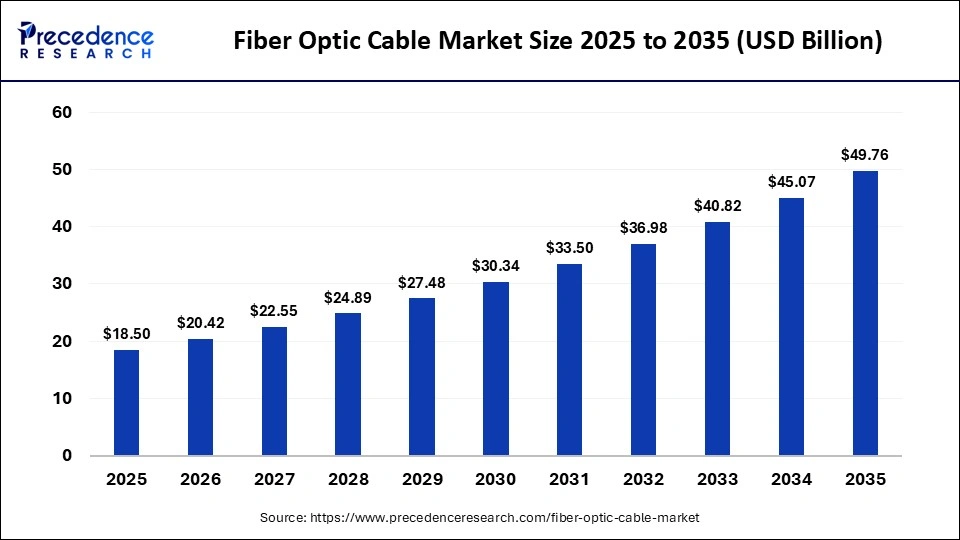
The global fiber optic cable market size was valued at USD 18.50 billion in 2025 and is projected to increase from USD 20.42 billion in 2026 to approximately USD 49.76 billion by 2035, expanding at a CAGR of 10.40% during the forecast period. The market is gaining strong momentum because of increasing demand for high-speed internet connectivity, rapid rollout of 5G networks, and growing investments in cloud infrastructure. Fiber optic cables are becoming essential for supporting low-latency communication, high-bandwidth applications, and reliable long-distance data transmission across telecom, enterprise, and public infrastructure networks.
The rise of artificial intelligence, industrial IoT, connected devices, and smart city projects is further increasing the need for advanced fiber infrastructure. Governments and telecom providers are investing heavily in broadband expansion programs, while enterprises are modernizing their communication systems to support next-generation digital services. Hyperscale data centers, AI platforms, and edge computing networks are also creating strong long-term demand for fiber optic cable deployment.
Read Also: Industrial Vacuum Cleaner Market
Quick Insights
- The fiber optic cable market was valued at USD 18.50 billion in 2025 and is expected to reach USD 49.76 billion by 2035.
- The market is forecast to grow at a CAGR of 10.40% between 2026 and 2035.
- North America dominated the market with a 38% share in 2025.
- Asia Pacific is expected to witness the fastest growth, expanding at a CAGR of 11% during the forecast period.
- Single-mode fiber optic cable held the leading share of 60% in 2025.
- Telecommunications represented the largest application segment with a 40% market share in 2025.
- Underground installation accounted for 50% of the market in 2025.
Fiber Optic Cable Market Revenue Snapshot
| Metric | Value |
|---|---|
| Market Size in 2025 | USD 18.50 Billion |
| Market Size in 2026 | USD 20.42 Billion |
| Forecast Market Size in 2035 | USD 49.76 Billion |
| CAGR (2026-2035) | 10.40% |
| Largest Regional Market | North America |
| Fastest Growing Region | Asia Pacific |
How Is Artificial Intelligence Influencing the Fiber Optic Cable Market?
Artificial intelligence is becoming one of the biggest demand drivers for the fiber optic cable market because AI systems require high-speed, low-latency, and highly reliable communication networks. AI workloads generate enormous amounts of data that must be transferred between servers, cloud platforms, and storage systems in real time. This is increasing the demand for advanced fiber optic infrastructure in data centers, telecom networks, and enterprise IT environments.
AI is also transforming how fiber networks are monitored and managed. Telecom providers are increasingly using AI-powered predictive maintenance tools, automated fault detection systems, and intelligent traffic management solutions to improve network performance and reduce downtime. As enterprises adopt AI-based operations, the need for advanced fiber connectivity will continue to rise.
What Are the Major Growth Drivers Supporting the Fiber Optic Cable Market?
One of the biggest growth drivers is the rising demand for high-speed internet connectivity. Consumers and businesses are increasingly using cloud computing, streaming services, remote collaboration tools, and digital entertainment platforms that require faster and more reliable communication infrastructure. Fiber optic cables provide higher bandwidth and lower signal loss than traditional copper cables, making them essential for next-generation networks.
The rapid expansion of 5G communication networks is another major growth factor. Fiber optic cables are essential for connecting 5G towers, base stations, and network backhaul systems. Telecom providers are investing heavily in fiber infrastructure to improve network reliability, support ultra-low latency, and meet growing internet traffic demand.
The increasing number of hyperscale data centers is also supporting market growth. Data centers require high-speed, low-latency, and scalable connectivity to support cloud services, AI workloads, and enterprise applications. As businesses continue to digitize operations, demand for fiber optic cable systems is expected to increase significantly.
Why Is Single-Mode Fiber Optic Cable Dominating the Market?
Single-mode fiber optic cable held the largest market share of 60% in 2025 because of its superior long-distance performance and high bandwidth capacity. Its single-core design allows only one light mode to pass through, reducing signal loss and improving data clarity. This makes it highly suitable for telecommunications, backbone networks, long-haul infrastructure, and submarine cable systems.
Multi-mode fiber optic cable held the second-largest share of 40% in 2025 because it is more affordable and easier to install in short-distance applications. Multi-mode fiber is commonly used in buildings, campuses, enterprise networks, and data centers where cost-effective connectivity is required.
What Opportunities Are Emerging from 5G and Smart City Investments?
The rapid expansion of 5G networks is creating one of the biggest opportunities for the fiber optic cable market. Fiber infrastructure is critical for supporting high-speed communication, network reliability, and low-latency data transmission in 5G environments. Telecom providers are continuing to invest in new fiber installations to support base stations and improve network coverage.
Smart city development is another major opportunity area. Fiber optic cables are increasingly being used to support connected transportation systems, smart grids, surveillance networks, public Wi-Fi systems, and IoT-enabled city infrastructure. Countries such as India, China, Japan, and the United States are investing heavily in smart city programs, which is expected to create long-term demand for fiber deployment.
Community discussions also indicate increasing interest in ribbon fiber technologies because they offer higher bandwidth, improved scalability, and better space management in dense network environments. Ribbon fiber is becoming increasingly important for large-scale telecom projects and hyperscale data centers.
Which Segments Are Leading the Fiber Optic Cable Market?
The telecommunications segment dominated the market with a 40% share in 2025 because of increasing demand for broadband services, mobile connectivity, and 5G networks. Fiber optic cables support high-bandwidth communication and are critical for long-distance and low-loss data transmission. Telecom providers continue to invest heavily in fiber infrastructure to support rising internet traffic and network modernization.
The data center segment held the second-largest share at 25% in 2025 and is expected to grow at a CAGR of 10.5% during the forecast period. This growth is being driven by rising demand for cloud computing, enterprise applications, AI workloads, and digital storage systems. Meanwhile, the military and defense segment is expected to grow at the fastest CAGR of 11% because fiber optics offer secure, high-speed, and interference-free communication systems.
Why Is Underground Installation Leading the Market?
Underground installation dominated the market with a 50% share in 2025 because it provides better protection against environmental damage, vandalism, and accidental disruptions. Underground fiber optic cables are widely used in urban areas and mission-critical sectors such as healthcare, finance, transportation, and government, where uninterrupted connectivity is essential.
The aerial installation segment accounted for 25% of the market in 2025 because it is more affordable and easier to deploy, especially in rural and suburban areas. Meanwhile, submarine fiber optic cable systems are expected to grow rapidly because they are essential for international communication and global internet connectivity.
Why Is North America Dominating the Global Market?
North America accounted for 38% of the global fiber optic cable market in 2025 because of strong investments in telecom infrastructure, rapid 5G deployment, and expansion of data centers. The region has witnessed strong growth in broadband connectivity, cloud computing, and AI-related infrastructure projects. The United States remains the leading market because of its large-scale investments in hyperscale data centers and advanced networking technologies.
Asia Pacific is expected to grow at the fastest pace because of rapid urbanization, rising telecom investments, and strong government support for digital transformation. Countries such as China, India, Japan, and South Korea are investing heavily in 5G, smart cities, and broadband connectivity programs.
What Are the Latest Breakthroughs and Innovations in the Market?
Manufacturers are increasingly focusing on bend-insensitive fiber, ribbon fiber technologies, eco-friendly cable materials, high-density cable systems, and AI-powered network management tools. These innovations are helping companies improve data transmission capacity, reduce installation complexity, and enhance network reliability.
What Challenges Could Restrict Market Growth?
Despite strong long-term growth potential, the fiber optic cable market faces several challenges. High installation costs remain a major barrier, especially for underground and submarine cable projects. Building fiber networks requires significant investments in equipment, labor, permits, and civil engineering work, making deployment expensive in rural and remote areas.
Raw material price volatility, supply chain disruptions, and shortages of skilled technicians are also creating pressure on the market. In many developing regions, limited funding and outdated infrastructure continue to restrict fiber deployment. Competition from satellite broadband and wireless communication technologies may also limit adoption in some areas.
Case Study: Hyperscale Data Centers Accelerate Fiber Demand
The rapid growth of hyperscale data centers is significantly increasing demand for fiber optic cable systems worldwide. Cloud providers, AI companies, and enterprise software firms are investing heavily in advanced fiber infrastructure to support high-speed data transfer and low-latency communication. In the United States, the growing number of AI-ready data centers is creating substantial demand for fiber deployment across cloud platforms and enterprise networks.
Get Sample Link: https://www.precedenceresearch.com/sample/8315
For inquiries regarding discounts, bulk purchases, or customization requests, please contact us at sales@precedenceresearch.com
