
Industrial Vacuum Cleaner Market to Reach USD 5.56 Billion by 2035
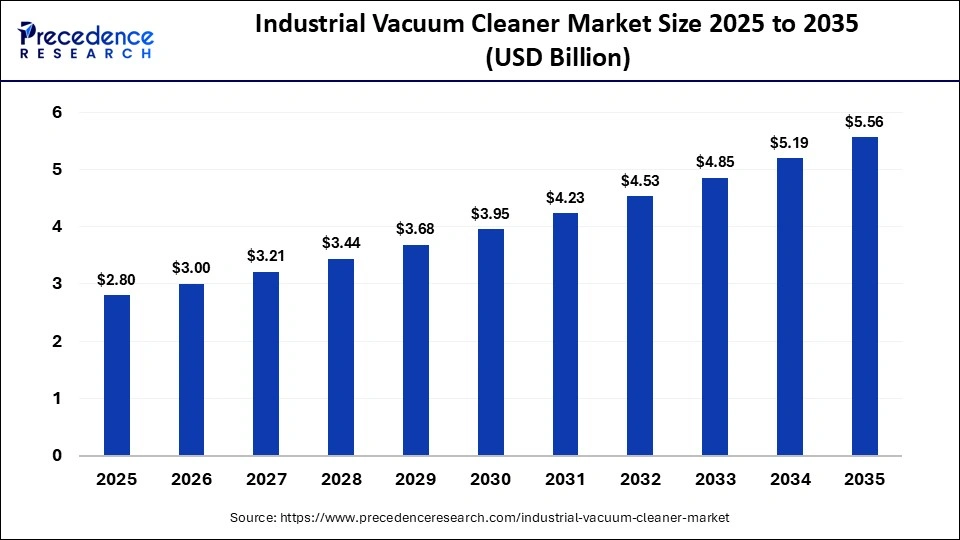
The global industrial vacuum cleaner market size was valued at USD 2.80 billion in 2025 and is expected to increase from USD 3.00 billion in 2026 to approximately USD 5.56 billion by 2035, expanding at a CAGR of 7.10% during the forecast period. Industrial vacuum cleaners are becoming critical across manufacturing, automotive, food processing, pharmaceutical, and heavy industrial environments where dust, debris, and hazardous particles can disrupt operations and create serious health risks. Rising industrialization, workplace safety mandates, and environmental compliance standards are accelerating market demand.
Industries are increasingly adopting advanced cleaning technologies to improve operational efficiency, reduce downtime, and maintain safe work environments. Demand is particularly strong for high-performance dry vacuum systems, HEPA-based filtration technologies, cordless units, and smart cleaning equipment integrated with IoT and predictive maintenance capabilities. The growing need for contamination-free production facilities and stricter regulations from occupational safety agencies are expected to further strengthen market growth.
Read Also: Network Diagnostic Tool Market
Quick Insights
- The industrial vacuum cleaner market was valued at USD 2.80 billion in 2025 and is expected to reach USD 5.56 billion by 2035.
- The market is projected to grow at a CAGR of 7.10% between 2026 and 2035.
- North America dominated the market with a 35% share in 2025.
- Asia Pacific is expected to witness the fastest growth, expanding at a CAGR of 9% during the forecast period.
- Dry industrial vacuum cleaners held the largest share of 50% in 2025.
- Electric-powered industrial vacuum cleaners accounted for 75% of the market in 2025.
- Manufacturing and industrial plants represented the leading application segment with a 40% market share in 2025.
- Heavy industries held the largest end-use segment with a 45% share in 2025.
Industrial Vacuum Cleaner Market Revenue Snapshot
| Metric | Value |
|---|---|
| Market Size in 2025 | USD 2.80 Billion |
| Market Size in 2026 | USD 3.00 Billion |
| Forecast Market Size in 2035 | USD 5.56 Billion |
| CAGR (2026-2035) | 7.10% |
| Largest Regional Market | North America |
| Fastest Growing Region | Asia Pacific |
How Is Artificial Intelligence Influencing the Industrial Vacuum Cleaner Market?
Artificial intelligence is reshaping the industrial vacuum cleaner market by improving equipment efficiency, predictive maintenance, and workplace safety. AI-enabled sensors can detect dust levels, monitor suction performance, analyze filter health, and track equipment utilization in real time. These intelligent systems help facility managers identify maintenance needs before breakdowns occur, minimizing downtime and improving productivity.
AI is also enabling centralized management of industrial cleaning systems through IoT integration. Smart vacuum cleaners can provide data on usage patterns, energy consumption, and performance efficiency, allowing businesses to optimize cleaning schedules and resource allocation. As more industries adopt Industry 4.0 and smart factory practices, AI-powered vacuum systems are expected to become increasingly common.
What Are the Major Growth Drivers Supporting the Industrial Vacuum Cleaner Market?
One of the key growth drivers is the rising focus on worker health and workplace safety. Industrial environments often generate fine dust, powders, liquid spills, and hazardous debris that can cause respiratory problems, contamination, and machinery damage. Industrial vacuum cleaners help companies maintain safer and cleaner workplaces while complying with occupational safety regulations.
Another major growth factor is the increasing demand for automated and energy-efficient cleaning technologies. Businesses are looking for cleaning systems that can reduce manual labor, lower operating costs, and support higher productivity levels. This is particularly important in industries such as food processing, pharmaceuticals, and chemicals, where strict hygiene and contamination control are essential.
The growing use of advanced filtration technologies is also driving the market. HEPA filters and multi-stage filtration systems are increasingly being integrated into industrial vacuum cleaners to capture fine particles and improve indoor air quality. These systems are especially important in cleanroom environments and facilities where dust control is a top priority.
Why Are Dry Industrial Vacuum Cleaners Dominating the Market?
Dry industrial vacuum cleaners held a dominant market share of 50% in 2025 because they are widely used to handle dust, powders, and other dry materials in industries such as construction, cement, manufacturing, and metal processing. These industries generate large amounts of dry waste that require continuous cleaning and effective filtration. Dry industrial vacuum systems are preferred because they provide strong suction power, large storage capacity, and efficient dust collection.
These systems are also increasingly equipped with advanced filtration, explosion-proof designs, and automated monitoring features that make them more suitable for hazardous work environments. Their versatility and effectiveness are expected to help them maintain their leading market position over the coming years.
What Opportunities Are Emerging from Smart and Portable Cleaning Systems?
The rise of smart factories and connected industrial environments is creating significant opportunities for industrial vacuum cleaner manufacturers. Businesses increasingly want cleaning systems that can integrate with predictive maintenance software, facility management platforms, and automated production lines. IoT-enabled vacuum cleaners with remote monitoring, automated start-stop functions, and real-time diagnostics are becoming more attractive to industrial buyers.
Portable and cordless industrial vacuum cleaners are also creating strong growth opportunities. Battery-operated systems provide greater mobility and flexibility, making them ideal for warehouses, construction sites, and remote industrial locations where power access may be limited. Community discussions also indicate increasing interest in Bluetooth-enabled vacuum systems, robotic cleaning technologies, and remote-controlled equipment.
Which Product Segments Are Leading the Industrial Vacuum Cleaner Market?
Dry industrial vacuum cleaners led the market with a 50% share in 2025, while wet industrial vacuum cleaners accounted for 30% of total demand. Combined wet and dry industrial vacuum cleaners represented 20% of the market and are expected to grow at the fastest CAGR of 8% because they can handle both liquid and solid waste in a single system. These hybrid systems are becoming more popular in industries such as automotive, construction, and manufacturing where mixed waste is common.
Electric-powered industrial vacuum cleaners dominated the market with a 75% share in 2025 due to their high efficiency, reliability, and lower operating costs. Pneumatic-powered systems accounted for 25% of the market and are expected to grow at the fastest CAGR of 8% because they are widely used in explosive or hazardous industrial environments where spark-free operation is required.
Why Does Manufacturing Continue to Lead Market Demand?
Manufacturing and industrial plants accounted for 40% of the market in 2025 because these facilities require continuous cleaning of floors, production lines, heavy machinery, and work areas. Dust and debris accumulation can damage equipment, lower productivity, and create unsafe working conditions. Industrial vacuum cleaners help reduce equipment wear, minimize downtime, and improve operational efficiency.
The automotive segment held a 15% share in 2025 because vehicle manufacturing requires precise cleaning of machinery, components, and paint booths. Food processing is expected to grow at the fastest CAGR of 8% due to increasing hygiene requirements and food safety standards. Pharmaceutical facilities are also adopting industrial vacuum systems to maintain sterile production environments and comply with regulatory standards.
Why Is North America Dominating the Global Market?
North America accounted for 35% of the global industrial vacuum cleaner market in 2025 because of its strong manufacturing base, high adoption of advanced cleaning systems, and strict workplace safety regulations. Industries in the region increasingly rely on industrial vacuum cleaners to maintain efficient operations, minimize dust-related risks, and comply with environmental standards.
The United States remains the largest country-level market because of strong demand across manufacturing, healthcare, construction, retail, and hospitality sectors. Regulatory frameworks established by agencies such as OSHA are encouraging businesses to invest in advanced industrial cleaning systems. Asia Pacific is expected to witness the fastest growth due to rapid industrialization, infrastructure development, and stricter workplace safety requirements in countries such as China and India.
What Are the Latest Breakthroughs and Innovations in the Market?
Manufacturers are increasingly focusing on cordless systems, robotic vacuum cleaners, advanced HEPA filtration, and IoT-enabled smart cleaning equipment. Features such as predictive maintenance, automated navigation, remote monitoring, and Bluetooth-based controls are becoming more common across industrial cleaning products.
In November 2025, Nilfisk introduced the VP25 industrial robotic vacuum designed for large commercial and industrial facilities. The product uses LiDAR sensors and intelligent navigation systems to map environments, avoid obstacles, and deliver consistent cleaning performance across different floor surfaces.
Major companies operating in the market include Nilfisk, Kärcher, Tennant Company, American Vacuum Company, Tiger-Vac, Delfin Industrial Vacuums, and Goodway Technologies.
What Challenges Could Restrict Market Growth?
Despite strong growth prospects, the industrial vacuum cleaner market faces several challenges. High upfront equipment costs remain a major barrier, especially for small and medium-sized enterprises. Advanced industrial vacuum systems often require durable materials, specialized filters, and explosion-proof designs, making them more expensive than conventional cleaning equipment.
Maintenance costs, filter replacement expenses, and integration challenges are also limiting wider adoption. Rising prices for raw materials such as steel, copper, and industrial-grade plastics may further increase manufacturing costs. In addition, some companies are hesitant to adopt advanced cleaning technologies because of budget constraints and limited technical expertise.
Case Study: Food Processing Plants Increase Adoption of HEPA Vacuum Systems
Food processing plants are increasingly using industrial vacuum cleaners with HEPA and multi-stage filtration systems to improve sanitation and comply with strict food safety regulations. These systems help remove dust, food particles, and liquid spills from production areas, reducing contamination risks and supporting regulatory compliance. Rising demand for packaged and processed food products is expected to further strengthen adoption of advanced industrial vacuum systems in this segment.
Get Sample Link: https://www.precedenceresearch.com/sample/8314
For inquiries regarding discounts, bulk purchases, or customization requests, please contact us at sales@precedenceresearch.com
