
Network Diagnostic Tool Market to Reach USD 7.63 Billion by 2035
The global network diagnostic tool market size was valued at USD 3.50 billion in 2025 and is projected to increase from USD 3.78 billion in 2026 to approximately USD 7.63 billion by 2035, expanding at a CAGR of 8.10% during the forecast period. The market is witnessing strong growth because organizations are increasingly managing distributed cloud environments, hybrid work models, multi-site networks, and digital-first operations. Enterprises now require continuous visibility into network performance, latency, packet loss, jitter, and bandwidth usage to maintain business continuity and customer experience.
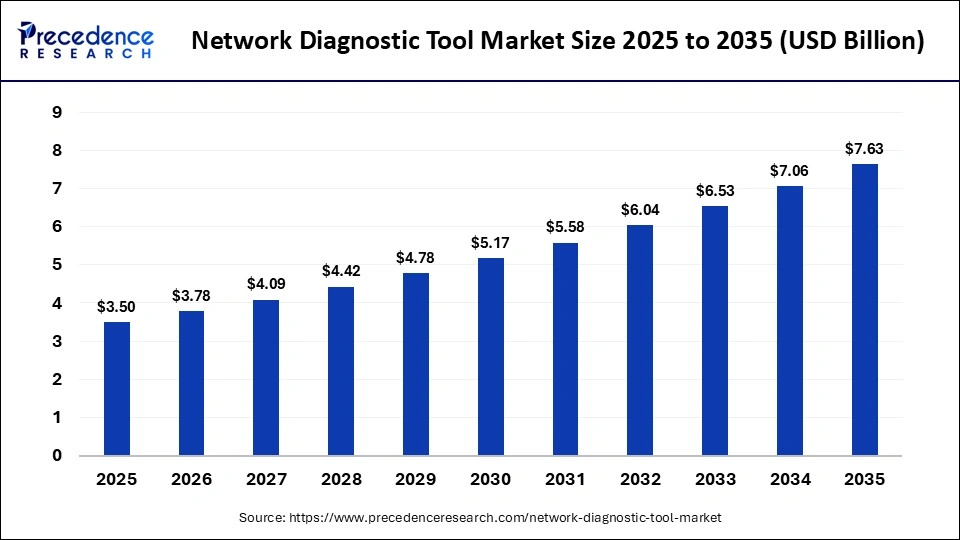
The rapid expansion of 5G networks, edge computing infrastructure, cloud-native applications, and software-defined networking is creating substantial demand for intelligent diagnostic platforms. Businesses across telecom, BFSI, healthcare, government, and retail are investing in real-time network monitoring tools to minimize downtime, improve security, and maintain application performance. Global internet traffic increased by approximately 19% in 2025, placing greater pressure on modern digital infrastructure and increasing the need for predictive observability solutions.
Read Also: AI Search Engine Market
Quick Insights
- The network diagnostic tool market was valued at USD 3.50 billion in 2025 and is expected to reach USD 7.63 billion by 2035.
- The market is projected to grow at a CAGR of 8.10% from 2026 to 2035.
- North America dominated the market with a 40% share in 2025.
- Asia Pacific is expected to grow at the fastest CAGR of 10% during the forecast period.
- Cloud-based deployment held the largest share of 55% in 2025.
- IT & telecommunication represented the leading end-use segment with a 40% market share in 2025.
- Network performance monitoring tools accounted for 35% of the market in 2025.
- Network monitoring and management represented the largest application segment with a 35% share in 2025.
Network Diagnostic Tool Market Revenue Snapshot
| Metric | Value |
|---|---|
| Market Size in 2025 | USD 3.50 Billion |
| Market Size in 2026 | USD 3.78 Billion |
| Forecast Market Size in 2035 | USD 7.63 Billion |
| CAGR (2026-2035) | 8.10% |
| Largest Regional Market | North America |
| Fastest Growing Region | Asia Pacific |
How Is Artificial Intelligence Influencing the Network Diagnostic Tool Market?
Artificial intelligence is reshaping the network diagnostic tool market by enabling predictive maintenance, anomaly detection, and automated troubleshooting. AI-powered monitoring platforms can process telemetry data from cloud, 5G, and edge networks far more efficiently than conventional monitoring systems. These platforms can quickly detect abnormal traffic patterns, latency spikes, service degradation, and bottlenecks before they lead to network failures.
AI is also helping enterprises reduce downtime through intelligent root-cause analysis and alert prioritization. Machine learning-enabled observability systems can identify which issues require immediate attention, reducing operational complexity for IT teams. As organizations adopt SD-WAN, SASE, and hybrid cloud models, AI-enabled diagnostics are expected to become essential for network resilience and service continuity.
What Are the Major Growth Drivers Supporting the Network Diagnostic Tool Market?
One of the biggest growth drivers is the increasing adoption of cloud and hybrid IT architectures. As businesses migrate critical workloads to multi-cloud environments, network infrastructures become more complex and harder to manage. Diagnostic tools provide continuous visibility into network health, service availability, packet flow, and application performance across distributed systems.
The rapid rollout of 5G and edge computing is another major catalyst. 5G networks require advanced monitoring tools capable of handling ultra-low latency, network slicing, and high device density. Similarly, edge computing environments need localized monitoring capabilities to support industrial IoT, smart manufacturing, connected healthcare, and intelligent retail systems.
Another important driver is the growing convergence between network diagnostics and cybersecurity. Enterprises increasingly require solutions that can detect both performance issues and suspicious network behavior, including intrusion attempts, malicious traffic, and abnormal activity across digital infrastructure.
Why Are Cloud-Based Deployment Models Dominating the Market?
Cloud-based deployment dominated the market with a 55% share in 2025 because businesses increasingly prefer flexible, scalable, and centrally managed monitoring environments. Cloud-based network diagnostic tools make it easier for enterprises to monitor distributed locations, remote employees, hybrid workforces, and multi-cloud ecosystems without requiring heavy on-premise infrastructure investments.
The growth of serverless computing, SaaS-based observability platforms, and edge-cloud integration is also strengthening demand for cloud-based deployments. These solutions offer lower upfront costs, easier implementation, automatic updates, and greater visibility across geographically dispersed environments. On-premise deployment accounted for 45% of the market in 2025 and remains relevant for highly regulated industries that prioritize strict data governance and operational control.
What Opportunities Are Emerging from 5G and Edge Computing?
The expansion of 5G and edge computing infrastructure is expected to create some of the most significant growth opportunities for the network diagnostic tool market. Telecom operators require advanced monitoring solutions to manage network slicing, virtualized functions, increasing data throughput, and rising traffic volumes associated with 5G environments. Global 5G connections surpassed 2 billion in 2025, highlighting the growing importance of advanced diagnostics and performance visibility.
Edge computing is also creating new demand because organizations are increasingly processing data closer to connected devices and end users. Businesses deploying industrial IoT, autonomous systems, smart factories, and connected healthcare infrastructure require localized monitoring solutions that provide real-time insights into network health and performance.
Which Product Segments Are Leading the Market?
Network performance monitoring tools led the market with a 35% share in 2025 because enterprises increasingly require real-time analytics and service assurance across telecom and IT environments. These tools help businesses monitor bandwidth, latency, network speed, and overall system performance in real time.
Network traffic analyzer tools accounted for 30% of the market in 2025 and are expected to grow at a CAGR of 8.5% through 2035. These tools are becoming increasingly important for identifying network bottlenecks, improving bandwidth allocation, and analyzing encrypted traffic. Network configuration and change management tools held a 15% market share and are expected to grow at the fastest CAGR of 9% because of rising demand for compliance, risk reduction, and configuration control.
Why Does the IT & Telecommunication Sector Lead the Market?
The IT & telecommunication segment dominated the market with a 40% share in 2025 because telecom operators manage highly complex and data-intensive networks that require continuous monitoring and optimization. Telecom companies depend on advanced diagnostic solutions to maintain uninterrupted voice, video, cloud, and data services. Rising investments in fiber connectivity, 5G infrastructure, and virtualized network functions are expected to further strengthen segment growth.
The BFSI segment held the second-largest market share of 25% in 2025 because financial institutions require stable, secure, and continuously monitored networks to support digital banking, payment systems, and customer-facing applications. Government and healthcare organizations are also becoming major users of network diagnostics due to increasing investments in digital infrastructure and connected services.
Why Is North America Dominating the Global Market?
North America accounted for 40% of the global network diagnostic tool market in 2025 because of its strong digital infrastructure, high concentration of hyperscale data centers, and rapid adoption of 5G, cloud computing, and software-defined networking. The region recorded more than 314 million 5G connections in 2025, reinforcing the need for real-time diagnostics and network observability solutions.
The United States remains the largest country-level market because of its advanced enterprise IT ecosystem and strong demand for AI-powered network monitoring platforms. Europe is the second-largest market, supported by strict cybersecurity regulations and digital transformation initiatives. Asia Pacific is expected to grow at the fastest pace due to rising telecom investments, expanding cloud adoption, and large-scale 5G deployment across China, India, Japan, and South Korea.
What Are the Latest Breakthroughs and Innovations in the Market?
Technology vendors are increasingly focusing on AI-powered observability, predictive maintenance, cloud-native monitoring, and automated troubleshooting solutions to address growing network complexity.
- In March 2026, GlobalConnect launched a network access control security service designed to improve access management and strengthen cybersecurity across enterprise networks.
- Vendors are increasingly integrating encrypted traffic visibility, anomaly detection, predictive analytics, and root-cause analysis into their network monitoring platforms.
What Challenges Could Restrict Market Growth?
Despite strong long-term growth potential, the network diagnostic tool market faces several challenges. High implementation costs remain a major barrier, particularly for small and medium-sized enterprises with limited IT budgets. Deploying advanced diagnostic systems often requires investments in software, hardware, integration services, and staff training.
Integration complexity is another major challenge because many businesses continue to rely on fragmented IT systems and legacy infrastructure. These environments can make it difficult to deploy modern observability platforms effectively. In addition, the shortage of skilled professionals capable of managing AI-powered diagnostics, cloud monitoring, and advanced network analytics continues to slow adoption in some regions.
Case Study: Automated Fault Management Improves Telecom Network Performance
Large telecom operators are increasingly adopting automated fault management tools to reduce downtime and improve service reliability. According to TM Forum, automated fault management reduced incident resolution times by more than 40% across large telecom networks in 2025. This highlights the growing importance of AI-powered diagnostics in helping businesses maintain service continuity across increasingly complex digital environments.
Get Sample Link: https://www.precedenceresearch.com/sample/8313
For inquiries regarding discounts, bulk purchases, or customization requests, please contact us at sales@precedenceresearch.com
